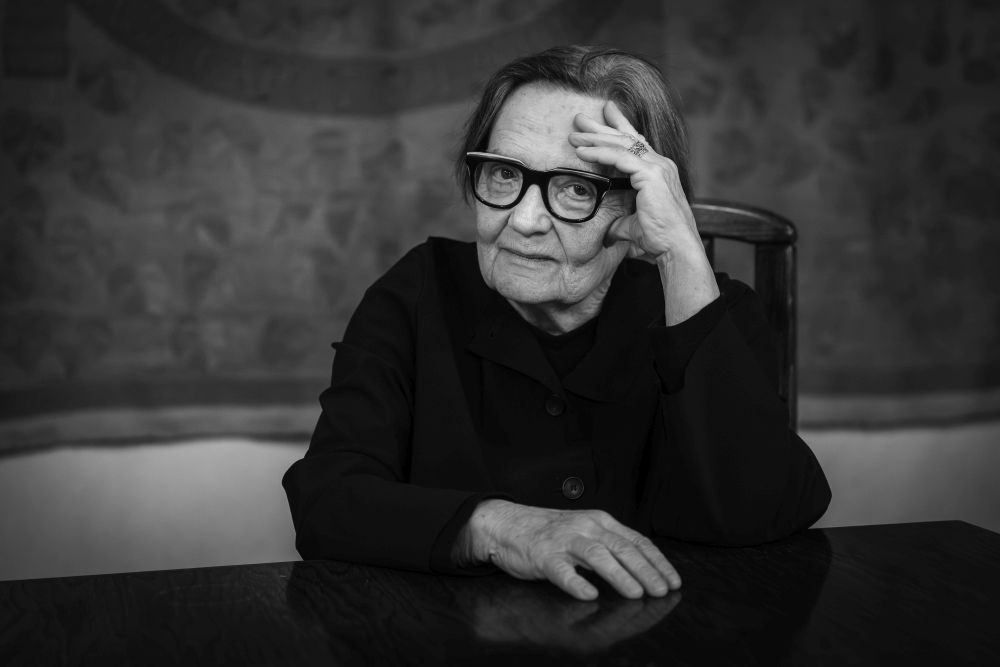
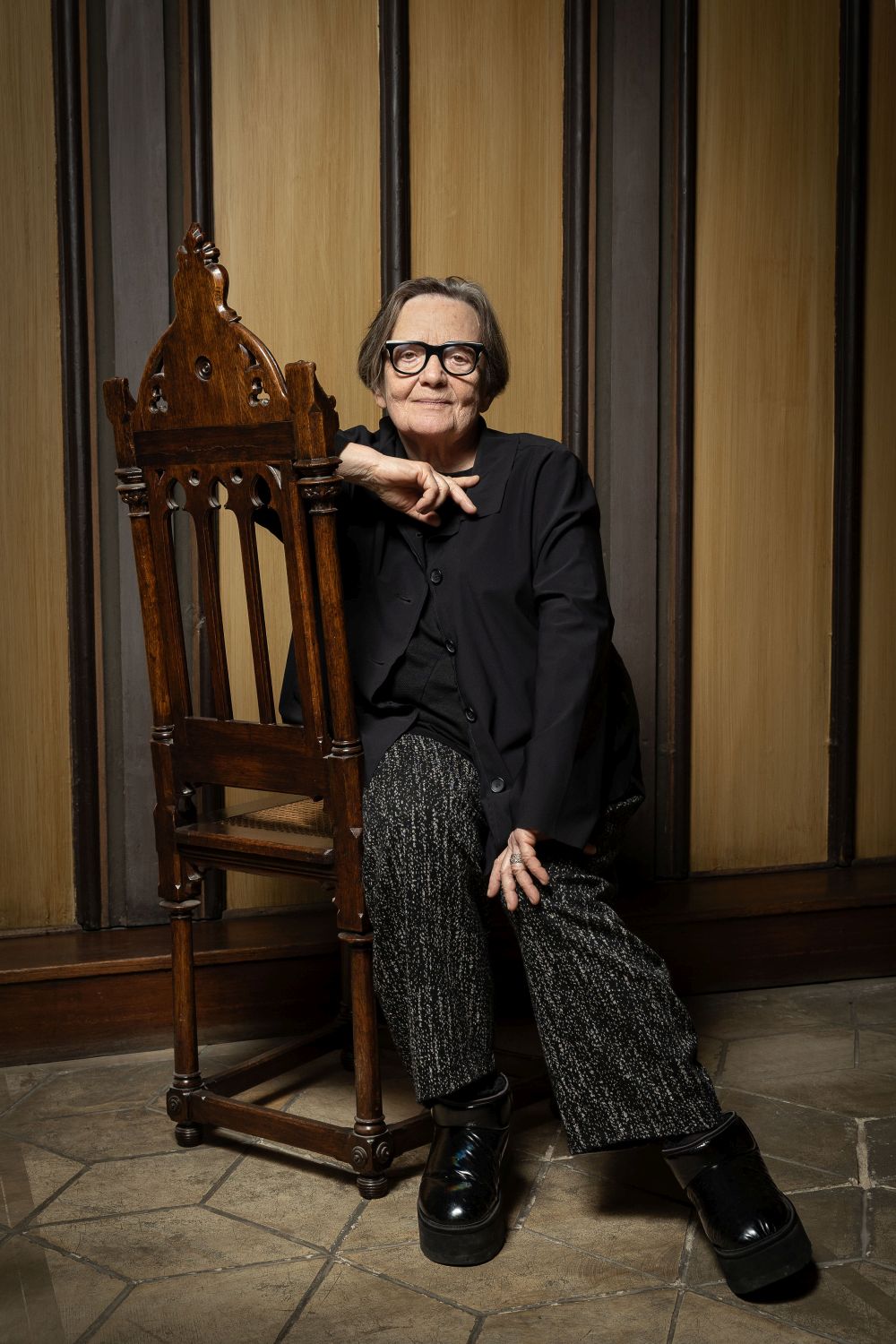
 She belongs to the same generation as Jan Palach; in fact, like him, she studied at university in Prague in the late 1960s, even though she came from Poland. The events that followed immediately after his act were then, more than 40 years later, adapted by film director Agnieszka Holland into the series Burning Bush. In doing so, she drew on her own personal experiences as well. In January, Charles University and the City of Prague awarded her the international Charles IV Prize for “a lifetime of artistic work devoted to issues of historical memory, experiences from the period of totalitarian regimes, and the defense of fundamental human rights and democratic values in an international context.” On that occasion, during this interview, she returned to the 1960s.
What was Prague like in 1966, when you started studying there?
In 1966, Prague was completely empty and dark, with the buildings’ facades worn down by time. Nevertheless, for a young person from Poland, which had been destroyed by World War II, it was an amazingly inspiring place, from an aesthetic, architectural, cinematic, human, and political point of view, because I was there at the time of the Prague Spring. I met my future husband here. Everything important for me happened in Prague.
What was the atmosphere among the students like at that time?
I lived on Hradební Street in the AMU dormitory, so it was full of musicians, actors, and filmmakers. I shared a room with three actresses, one of whom I am still friends with today, while the other two have sadly passed away since. I was young, I was in a city that was incredibly inspiring, and there was so much going on in music and film at the time – it was 1968. It was just wonderful.
Milan Kundera was one of your teachers at FAMU…
He’s been a massive inspiration to me. He was teaching literature to freshmen at the time. Unlike my classmates, I knew the books and authors he talked about and who fascinated him at the time, which was mainly German-language literature from the first half of the 20th century. In Czechoslovakia, unlike Poland, much of this literature was banned. I was the only Polish student in my class, and I knew the books he talked about, so he remembered me right away. When I later met him and his wife Věra in Paris, they took me under their wing and we became friends. I then translated his Unbearable Lightness of Being into Polish.
Which other influential figures did you encounter during your studies?
During my studies, I met a lot of people who had a significant influence on my work. One of them was the director Evald Schorm. He was an excellent person. He exuded such moral strength. I particularly like his films Courage for Every Day and The Return of the Prodigal Son.
The head of my class was Karel Kachyňa. It was interesting to meet him too. I used to think Otakar Vávra was a collaborator, but he was also quite a character. Only years later did I learn that when I was arrested, he defended me, even though I don’t think he liked me very much because I was quite cheeky (Agnieszka Holland was briefly detained by the State Security in the early 1970s in connection with her involvement in student and political activities – author’s note.).
I also have fond memories of Jan Matějovský, who mainly focused on television production. He taught us a sort of directorial psychology – how to interact with actors, how to establish authority among the crew, how to reconcile differing ambitions.
You received the Charles IV Prize on the eve of the anniversary of Jan Palach’s self-immolation. Where were you in January 1969? Did you sense the lethargy into which, as Jan Palach wrote in his letter, society had fallen after the August occupation?
When it happened, I was in Poland, where I had gone for the Christmas holidays. They then confiscated our passports and refused to let us return to Czechoslovakia. So I didn’t spend the days immediately following his self-immolation in Prague. However, I returned to Czechoslovakia shortly before Jan Zajíc burned himself (he set himself on fire on Wenceslas Square on 25 February 1969, a month after Jan Palach’s funeral – author’s note), and I remember that very well because my friends were filming a scene on Wenceslas Square that very day. Someone from the crew ran to the faculty to tell us, so we all ran there.
My friend, author Eda Kriseová, wrote a report about it, which to this day remains a very important record of that period. She captured the shift in public opinion that took place between the self-immolations of Jan Palach and Jan Zajíc. By the time Jan Zajíc did it, no one wanted to know or hear anything about it anymore. I partly showed this in Burning Bush.
You were born in the same year as Jan Palach. How did twenty-year-old Agnieszka Holland perceive his act?
I am likely influenced by Polish romanticism; the idea that we must fight, that we cannot simply give up on everything, and that it is up to us how things turn out. I accepted it as heroism; I did not question whether it was permissible or not, whether he was completely sane or not. I don’t know if I’d have the courage to do it, but I would definitely be on the side of those who decide that something must be done, even if they pay the highest price for it – their lives. But I think it had the opposite effect. People perceived it so that if freedom means sacrificing your life, then they would rather choose life and let their freedom be taken away. That’s why such a reversal took place.
 Do you still perceive his actions that way? Have you not reconsidered it even as you were filming Burning Bush and revisited that period very intensely, but enriched by forty years of life experience?
When you feel like you’re facing a wall of evil, you desperately grab onto anything you can. Your only weapon at that moment is your own body. I don’t condemn that, nor do I question it. When we made Burning Bush, we showed what it meant for Palach’s family, understandably thrown into despair by his act. Every suicide causes despair, even if you commit it with noble intentions.
Which of your own experiences and memories from the late 1960s and early 1970s did you incorporate into Burning Bush?
When I first read the script for Burning Bush, which was sent to me by an unknown screenwriter along with two producers, I thought it must have been written by one of my classmates whom I had forgotten about. It was so accurate, capturing the era, our feelings, reactions, and reality as it was.
I wrote them that I was interested in filming it and invited them to Warsaw. When they showed up at my door, there were these three kids standing there. They were still students, but they had incredible enthusiasm. Štěpán Hulík wrote a brilliant script, so we came to an agreement.
In the series Burning Bush, you also make significant use of the settings in which the story takes place, including the Faculty of Arts at Charles University, where Jan Palach studied. Do you deliberately use the environment as another character?
The Faculty of Arts building is a space imbued with both memory and presence. The place is alive with young people still studying there, but it is also a place where history has been made. You can sense this in the space, and with the view of the Castle, it is simply a symbolic place. And I have to say that it was a great place to film; it’s a shame we didn't have more time there.
In your work, you often focus on historical events, filming the fates of real people, such as Jan Palach, his family, and lawyer Dagmar Burešová, who represented the Palach family. How much do you rely on historians and eyewitness accounts?
I always do rigorous research; I want to learn as much as possible about the period itself and about the people I am portraying. If witnesses are still alive, I try to meet and talk with them. In the case of Burning Bush, we spoke with Jiří Palach, Jan’s brother, and several witnesses, and I also remember many of the events very well myself. In this case in particular, we really didn’t want to underestimate anything, because we realized how important the topic we were dealing with is for this country.
Of course, you have to make some changes for the purposes of film narration. For example, the entire student crew that appears in Burning Bush is fictional. We had to compile several real-life characters into the ones that appear in the story. I myself had friends in the student movement and was a member of the FAMU strike committee, so I knew how to portray it truthfully. We took a similar approach when depicting Dagmar Burešová’s colleagues.
When you’re writing biographies of actual historical figures, there is always going to be a bit of imagination involved. You can have hundreds of testimonies, letters, diary entries, but you still won’t be able to figure out exactly what that person was like on the inside. The creator’s imagination will always be reflected in how they portray their hero.
You often draw on themes from the recent past. You have always been convinced that you want to make feature films. Were you ever tempted by making documentaries?
I came closest to it in the case of Green Border. A few weeks after the refugee crisis began on the Belarusian-Polish border in 2021, I knew I had to make a film about it. But it wasn’t possible to shoot it in a documentary style. A few nice documentaries were made about it, but they always told the story from a kind of distant perspective. I needed to approach it differently. I wanted to show what the situation meant for the refugees, for the border guards, for society. I couldn’t have captured the things I openly show in the film in a documentary.
The tragedies of the 20th century affected not only the lives of your parents and loved ones, but also your own. How much did your personal painful experience with totalitarian regimes influence your work?
I grew up in bombed-out Warsaw, which on the one hand was a great playground, but on the other hand, from time to time, forgotten ammunition would explode there. One of my young friends tragically died this way. There was a constant, almost physical presence of danger. My father was Jewish and spent World War II in the Soviet Union in the army. His entire family perished in the Holocaust. When he returned, he found his city in ruins and never saw his loved ones again. He withdrew into himself and never spoke to me about it. He died when I was thirteen. My mother actively participated in the Warsaw Uprising, saving Jews. I personally experienced the horror, danger, and criminality of humanity from a very young age.
You repeatedly point out that the “Holocaust vaccination” effect is wearing off, meaning that humanity is slowly forgetting the horrors it is capable of committing under the influence of nationalism and racism. What role should universities play in strengthening the effectiveness of this vaccine?
One of today’s major dangers is that people no longer talk to each other physically; there is no dialogue. Instead of dialogue, conflict develops on social networks, fueled by algorithms. All it takes is for someone to express an opinion that is slightly different from the mainstream, and everyone immediately pounces on them.
Universities and schools are among the last places where dialogue is possible. Young people need to form their own worldview without being manipulated by algorithms, understand what is and what is not factual, learn to respect different opinions, understand that life is complicated – in short, learn everything that makes us good people. This is the role of universities, which are like a last refuge. Unfortunately, however, I think they devote too little attention to this task.
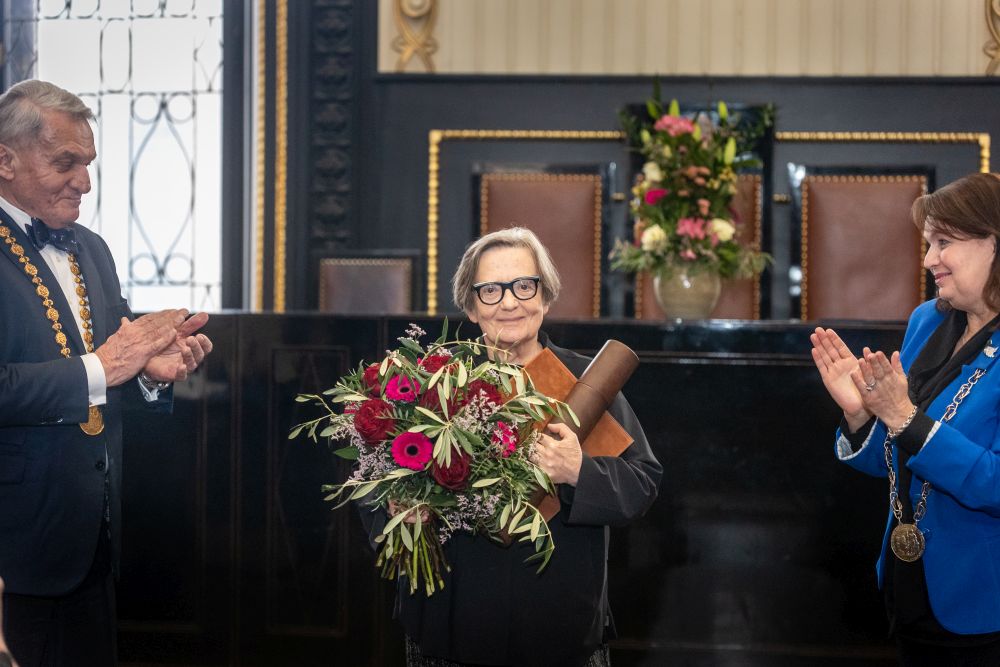
Agnieszka Holland received the international Charles IV Prize from Milena Králíčková, Rector of Charles University, and Bohuslav Svoboda, Mayor of Prague (photo: Hynek Glos).
Will film survive the advent of social media, further compounded by the development of artificial intelligence?
It will survive, the question is in what shape. The need for audiovisual narration has been with us since ancient times. There are certain areas of filmmaking that artificial intelligence will take over very quickly. You can use artificial intelligence as a useful tool, but if it turns into a Golem, it will be over.
You came to Prague as a young admirer of Franz Kafka, only to return fifty years later and dedicate your latest film to the famous writer. Did you regard the film Franz as your life’s project?
I hadn’t thought about it that way. For a long time, I even thought it couldn't be made into a film, because I felt that in Franz Kafka’s case, everything played out between his head and the paper, so it basically couldn’t be captured on film.
But then I was filming Charlatan, which meant I was living here for quite a long time again, and I saw everything that was happening around Kafka. I realized that he was present here in some way and that I had to try to find out how. It was a kind of experiment.
What did you project from your personal perception of Franz Kafka into the film?
His fragility, humor, and physiognomy were key to my film. It also helped that we found Idan Weiss, who played Franz. He is not only a very talented and sensitive actor, but also kind of a reincarnated Franz Kafka, both in his physiognomy and his mental sensitivity.
This film also got you into Charles University. Scenes from the insurance company where Franz Kafka worked were shot at the Faculty of Law, which, incidentally, is a very popular place among filmmakers…
The actual building of the insurance company where Kafka worked was in the Fin de Siècle style, full of paintings and sculptures. In this section of the film, however, the architecture is meant to express Kafka’s alienation in a certain way, which is why we chose the Faculty of Law building; we felt that it worked better there.
What project are you currently working on?
I have a beautiful script about the writer Jerzy Kosiński, author of The Painted Bird. It is a bit difficult to do one writer after another, but this story is quite different. It asks modern questions about what artistic truth is, whether it is more important than facts, or whether imagination can be truer than actual truth, and how easily you can discredit a person. Today, in the age of social media, when this is very easy to do, it is particularly relevant. Jerzy Kosiński is a very ambivalent hero, a bit The Charlatan, while Franz Kafka is more of a futuristic angel.
Do you feel you have an artistic debt to any particular subject?
I had scripts that would have made great films, but for various reasons they never got made. It’s difficult to return to certain topics because times change, the world’s sensibilities change, and some topics are suddenly not nearly as relevant as they once seemed. I don’t look back. I don’t have a list of things I want to do. I’m not sure about some of the things that I thought I’d like to film last year, mainly because of what’s happening in the world today. Suddenly, they’re not important, and what’s most important now, I don’t know.
| Agnieszka Holland |
|
|