 CU MATHPHYS’ Stefano Pozza and his international collaborators were awarded the prestigious ERC Synergy grant. Their project named “Ode to the Stars” – or, in full, “Formal and Numerical Solutions of Differential Equations for Nuclear Magnetic Resonance Sensitivity in the Star Algebra” – has, despite all the space-related terminology, nothing to do with cosmology. The star-algebra is in fact an innovative mathematical structure, and this project aims to develop breakthrough methods based on it, with applications in materials analysis and development and far beyond.
The multinational team consisting of nuclear magnetic resonance spectroscopist Christian Bonhomme (Sorbonne University, Paris) and mathematicians Pierre-Louis Giscard (University of the Littoral Opal Coast, Calais) and Stefano Pozza (Charles University) will be bestowed nearly €8.5 million for their frontier research. Their “Ode to the Stars” is only the third ever ERC Synergy project awarded to the Faculty of Mathematics and Physics, after POCOCOP (Libor Barto, 2022) and DYNASNET (Jaroslav Nešetřil, 2018).
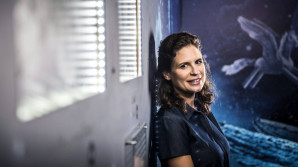
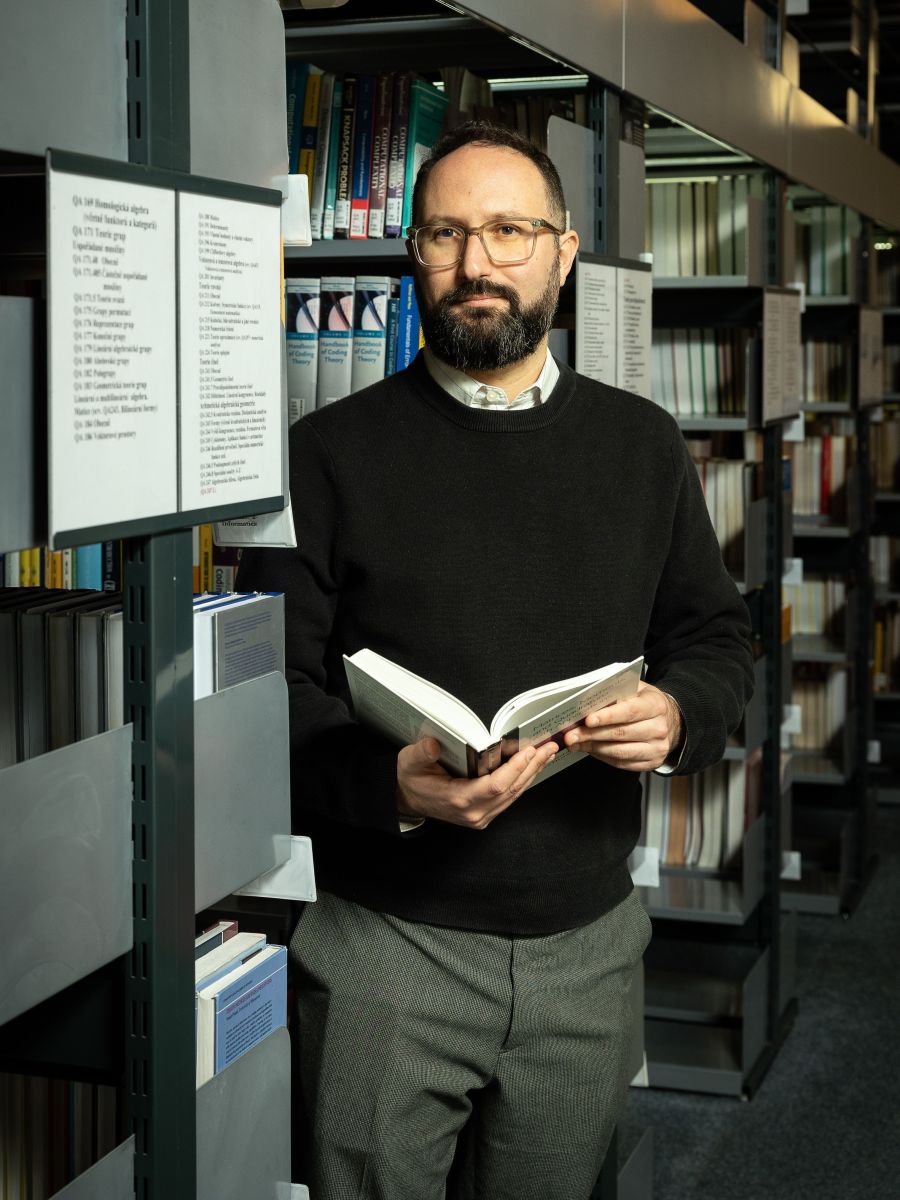
Associate Professor Stefano Pozza, currently working at the Department of Numerical Mathematics, is at the helm of developing new algorithms for this complex scientific project. In this Forum magazine interview, he gives a glimpse into the idea behind his project, its possible applications, as well as his life in Prague.
The native of the picturesque spa town of Recoaro at the foot of the Italian Alps studied mathematics at the University of Padua, specialising in numerical analysis, a branch of applied mathematics that studies and develops algorithms for scientific computing. His research eventually led him to the Faculty of Mathematics and Physics at Charles University. This welcoming environment, as he says, allowed him to pursue science further.
Preparation and hard lessons
Stefano Pozza’s development of complex equation solving methods dates years back. In fact, this research grew out of ideas first developed under a Primus grant at CU. This five-year-grant allowed him to discover some of the theoretical foundation on which the ERC proposal was built. Stefano Pozza and Pierre-Louis Giscard joined by Christian Bonhomme later applied for an ERC Synergy grant, but did not succeed in its merciless academic competition. “Unfortunately, we did not reach the second stage of the selection process. But even when you are facing rejection, you gain information: we received positive and negative feedback from the anonymous referees. Even when you feel it might be unfair, or at least not agreeable, it is still useful as you can understand their perspective and so you can use it as an advantage to improve for the next proposal.”
With an understanding of the project’s weak spots and opportunity to come in stronger next time, Stefano agrees this first rejection might have been a blessing in disguise, in the end. But the team did more than just improve the proposal itself: “We didn’t re-apply immediately, but two years later because we wanted to develop a few new things before submitting the proposal again. We wanted to show clearer proof that we actually could do what we’d promised. So the rejection was useful in some sense, even though, of course, it was frustrating, as it always is.”
But even more demanding than coming to terms with an understandably disappointing rejection, Stefano says, was preparing for the interview. “The three of us spent the entire summer meeting, going up and down to France and back every two weeks to prepare for it. Luckily, we were helped by Charles University, and Sorbonne organized mock interviews where we could practice. Of course, the first time we tested our presentation, in the ten minutes everyone has, was a disaster. We did not keep one single slide – well, maybe just the first slide with our face and the names. That’s the only slide that survived until the end (laughs). That was at the end of July! And then we did this process two more times. But eventually, we felt that we were finally ready, and it worked out. The competition was tough, with only about 5 % of proposals selected, but we made it!”
Success!
Clinching an ERC grant, especially in the highly competitive and prestigious Synergy category, is no mean feat, as Stefano testifies himself. “Oh, it’s a lot of work. When you write an ERC proposal, the most difficult part is really focusing and understanding at the core what is crucial and what is not. Then you must try to make this understanding that you have understandable for other people. On top of it, in this category, you must work around all of it with other two people. And here I must say I’ve been very lucky because Christian and Pierre-Louis are the best companions I could have found for this journey.”
“My role is to lead the design of new, efficient algorithms that can simulate experiments that are currently too expensive to compute, because they take too much time or memory to be useful in a chemistry lab.”
Yet Stefano is quick to name the exciting and satisfying parts to the ordeal, too – even before speaking of the hardships: “First of all, the ERC Synergy Grant brings a lot of joy. It took a great deal of work to get here, and it still feels like a dream. Most importantly, it is the best opportunity to develop our ideas to their full potential. An ERC grant not only provides the resources for such an ambitious goal, it is also a recognition by world-renowned experts that our ideas have the potential to substantially push forward the frontier of knowledge. Applying for an ERC grant required me to rethink my own work, understand the most important aspects of our ideas, and engage with the advice – and sometimes the rejection – of leading figures in my field. Making the most of this experience improved my scientific work and, I believe, was at the core of our successful application.” The exciting years that Stefano now anticipates were of course possible not only thanks to his hard work and fellow team members, but also the ones closest: “I am especially grateful to my friends and family, and in particular to my partner Alessandro, who supported me throughout this entire journey.”
An ODE to Star Algebra
Now, what does this scientific journey entail and where does it lead? For those uninitiated in mathematics, differential equations or a mysterious “star-algebra” might come across as very – to use some astronomical language – nebulous. In the simplest of terms, Stefano Pozza is developing a new way to solve very complex mathematical equations. The catch, however, is in the assignment itself: “the solution to these equations cannot simply be written as a formula”. How can we picture this statement? What even is the solution, then? “Yes, that’s probably a very obscure sentence from my side,” Stefano admits with a smile. “I’ll try to fish for some memories from high school algebra… So, for example, when you start solving an expression or equation, you must find x, and this x will typically have a formula involving some operations that gives the solution – that is a formula that expresses the solution to a problem. But then in mathematics things can quickly get more and more complicated, as I’m sure people experience a bit in their life, and often solutions to mathematical problems cannot be expressed in such an easy way.” For this ERC team, the complicated things in question are so-called ODEs: “Ordinary differential equations are classical tools to describe phenomena that can be found everywhere in the world and in technology. From a mathematical point of view, these equations can become very difficult to solve with an explicit formula when they are ‘non-autonomous’, which is a type of problem that typically arises in nuclear magnetic resonance. In general, you cannot really write ‘x equals to’ followed by an expression built from standard operations, square roots, exponentials, and other classical mathematical functions, because no such formula exists. But we found out that there is a new way to actually write down ‘x equals’ to an explicit formula in certain cases where no such formula was previously known.”
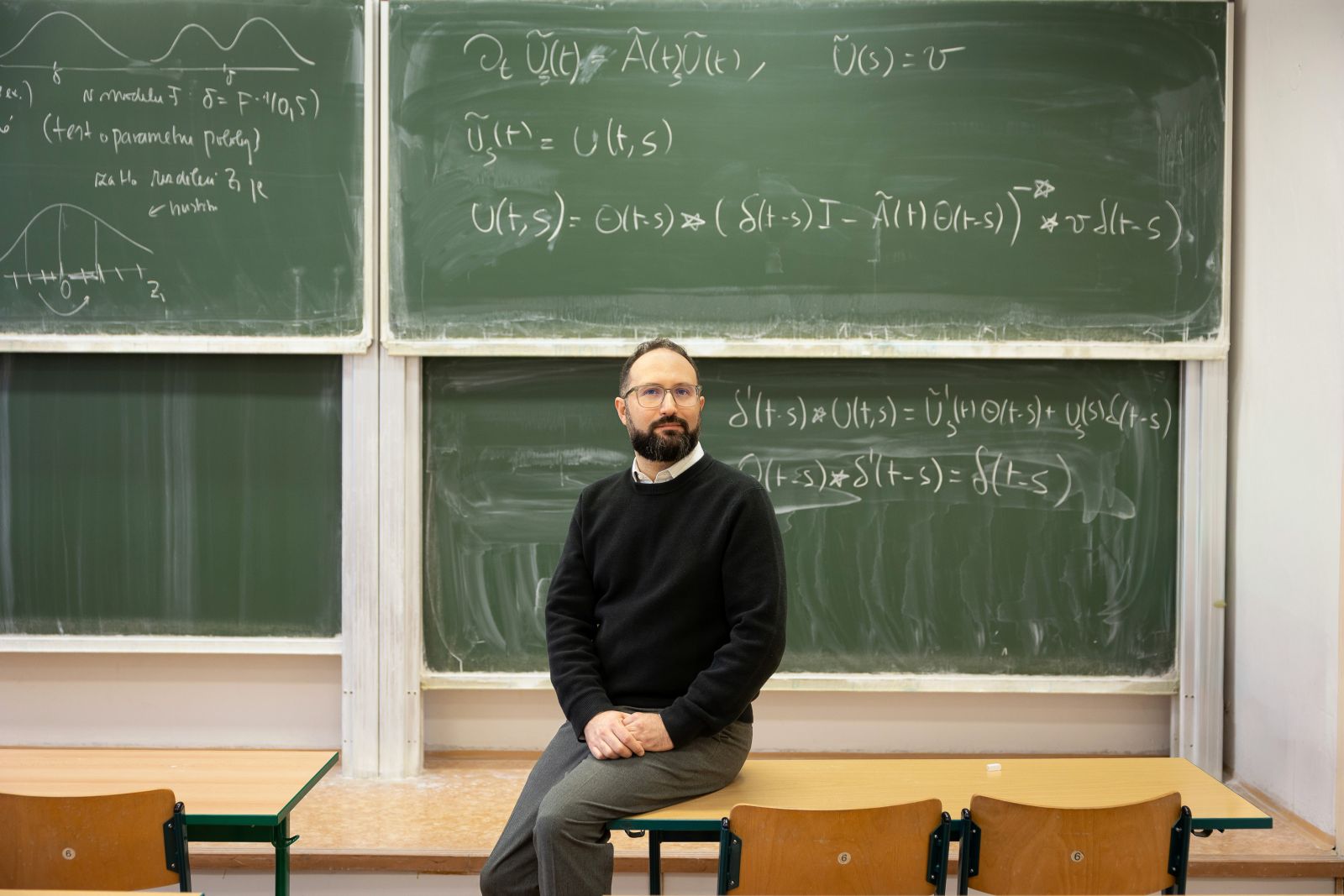
It certainly is hard to wrap your head around such a notion – trying to solve a formula and still ending up with a formula – if you’re not a mathematician. Stefano explains how nowadays there are basically two ways to do this kind of mathematics. “On one side you have explicit formulas, so ‘x is equal to…’ and a result. With implicit formulas, on the other hand, you cannot do that. My work usually lies here, with computers and algorithms to approximate the result numerically, which means that at the end you don’t have a formula, but you can actually have a number – the approximated solution, according to the algorithm, is 0.3, for example. These two kinds of ‘faces’ of mathematics influence each other; if you have access to an explicit formula, you can also improve the computational work.” And here is where Stefano’s role in this project comes into play. “I am working in scientific computing – my role is to lead the design of new, efficient algorithms that can simulate experiments that are currently too expensive to compute, because they take too much time or memory to be useful in a chemistry lab. Simulating experiments quickly on a computer is essential, since it allows chemists to test and optimise their experiments before investing time, resources, and money in the lab. The other mathematician on the team, Pierre-Louis, is working more in the explicit expression. And we work together in order to improve each other’s work, because we can help each other.”
Their novel approach is based on what they call the “star-product”. This makes it possible to express the required solution in a formal way more easily. One of the main challenges of this particular project is to turn this formal star-product expression of the solution into explicit formulas and computational algorithms that chemists and other practitioners can then use for their own research.
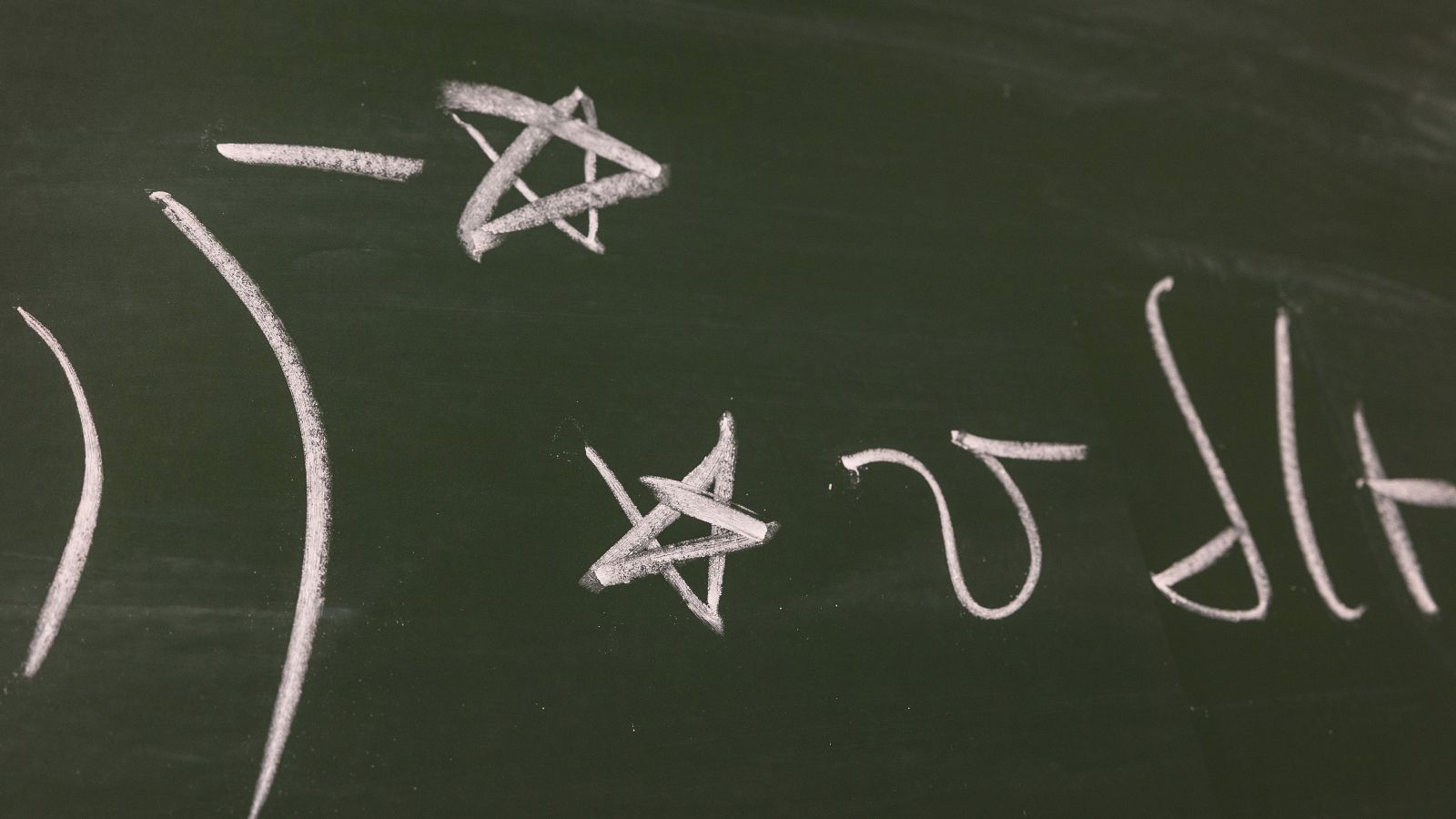
The name of the project, “Ode to the Stars”, then combines “ODE” (ordinary differential equations) with a so-called “star-product” (a formal expression of the equation’s solution). A wonderfully poetic name, but how did it come into being, and why a star in particular? “It’s actually just by chance. Instead of a usual x or an asterisk for a mathematical product, we started denoting it as a star symbol. Basically, a shorthand became the name. It's probably not even that original, but we like it.”
“I think that the best things in science happen when you have someone asking a good, concrete question, and you at least try to give an answer – and you discover something that may be more general.”
Allowing a design-based approach for material development
Although Stefano himself is entrenched in complicated mathematics, the ERC-backed project does have a readily applicable, physically experimental part, namely in Nuclear Magnetic Resonance. “It is the same technology used in hospitals for medical diagnosis, but in our case, it is used to identify the structure and properties of molecules. This is fundamental for designing new materials, for instance materials for surgical implants that the body will not reject. While extremely powerful, NMR is still not sensitive enough for many practical problems, and this is where our mathematics comes to help.”
But how does developing algorithms to solve complicated mathematical equations then work with nuclear magnetic resonance in particular? “For example, let’s say Christian, a chemist, wants to study a sample – he needs to analyse it with an NMR spectroscope. That is no easy task. You need to understand how to create the pulses that are going to influence the sample material. Now, I’m not a chemist, so I apologise to the experts, but you need to know how to prepare and set all the tools to get the signal you need and how to recover information from the sample you want to measure. All of this can be modelled as an ordinary differential equation. In other words, you can describe the entire process of this machine as a mathematical problem. Now, the issue is that, in this setting, we do not have access to explicit solutions – you cannot simply extract from the mathematics the best way to do the chemical analysis. Also, current algorithms are often very computationally expensive – the computers take so much time to get to the answer that many experiments simply cannot be simulated. So, at the core of our project, there is the idea that now we have a new way to solve these equations. By using this new approach, we will get solutions that will make life in the lab easier, and also new software that chemists in the lab can use to optimise and discover new things.”
 Still, the promising outlook of safer surgical implants yet lies in the future: “Right now, the project is not about the reactivity of implants. That might come after, but its essence is allowing for a paradigm shift. To move from an empirical way to produce new materials towards a more design-based approach. What you can do now is mostly to try a new material and see how it works. And then trying another one and seeing, alright, this is better than the other one – let’s try to move in this direction. It is a trial-and-error approach. If we want to go towards a more design-focused approach, we need a reliable way to simulate the materials that we want to use with a very precise, refined mathematical description – and a way to compute the solution. This way, we could simulate the material in the computer, see what happens and then optimise in an automated way the materials we want to use and their precise properties. Our approach blends explicit solutions and our new computational methods, allowing the materials researchers to move towards a more design-based approach.”
So, the implants are only one of countless possible applications – not only in material development chemistry, but all across the field. “That’s the main goal. We want to provide new tools and approaches for analysis in the lab with a huge variety of possible uses. The crucial point here are complex materials with different kinds of structures combined together and different kinds of complex dynamics.”
Can he say who – or which problem – inspired whom? Was it that the NMR experts and the material design researchers needed this new method or that Stefano and his team were on the cusp of a new discovery and only then found the application? “This was actually very instructing about science for me,” he smiles immediately, “because about seven years ago, I met Pierre-Louis at a seminar. We started discussing our topic and quickly realised that it was possible to express the solution of this kind of ODE through a completely new approach. We were talking about the mathematical problems, the computational problems, the algorithms and so on. But at the same time, Pierre-Louis had already been contacted by Christian, the chemist. For years, Christian also has been tackling a difficult problem of his own, hoping there must be something better that can be done with it. And then he came across to one of Pierre-Louis’ papers and got in touch. So, we all started working together. And this kind of teamwork then drove all of us towards new discoveries in our own fields. I think that the best things in science happen when you have someone asking a good, concrete question, and you at least try to give an answer – and you discover something that may be more general and it gets interesting also from the mathematical point of view.” No wonder then, this project was awarded in the Synergy category of ERC grants – fulfilling exactly what Stefano just described.
This point of view in particular, home to Stefano, should certainly not be overlooked, because that is what will allow all the possible applications: “I’d like to underline that this contribution will go towards mathematics as well. And this is even more general, because it is a new way to solve these kinds of equations, which can be applied to the most diverse kinds of fields – from economics to physics and so on, because in the end, they all deal with the same kinds of equations.”
A welcoming environment…
There’s absolutely no surprise, given his scientific background, but also the whole ERC circuit, that the support and guidance of Professor Zdeněk Strakoš must have been important for Stefano Pozza. “I met Prof. Zdeněk Strakoš at a conference many years ago, during my PhD. We began collaborating, and I visited Charles University several times. After two years of research in Italy, mainly at the University of Bologna with Prof. Valeria Simoncini, I moved to Prague for a postdoctoral position at the Department of Numerical Mathematics at Charles University.” That was nearly ten years ago. But going forward, this connection only proved to be paramount: “Yes, Prof. Strakoš played a crucial role in my development as a young researcher, first as a mentor and later through his invaluable help and advice in preparing the proposals. I am also grateful to the support teams at Charles University and Sorbonne University. Importantly, the welcoming and supportive environment I found at the Department of Numerical Mathematics was also one of the reasons I decided to develop my project here and make Prague my home.”
CU MATHPHYS’ researchers seem to agree the faculty is a true scientific powerhouse, but also a pleasant environment, and Stefano is no exception: “It is the place to be, from the human side, and the scientific. Indeed, the Department of Numerical Mathematics is internationally very well-known and home to a very strong scientific group.”
…and a beautiful city
When offered the office’s drip coffee before our interview, Stefano graciously accepted, assuring that he holds no stereotypical Italian tastes – all the more, after practically a decade of living in the Czech Republic he grew accustomed to many local things, including a regular cup of joe. But he does immediately profess happiness with his life here. “I moved here for a postdoc, initially for two years. At the beginning, I did not move here with a particular plan beyond that I wanted to work at the department. But I quickly found a welcoming environment and a very motivating place to work. I was offered a clear route for improving my work, along with the support I needed. Speaking of which, finding funding as a young student or researcher is not easy, and seeing that Charles University offers these kinds of grants that are open to exploring original ideas of young researchers, also made a big difference.”
“So, I must be honest, the first reason I moved here was for work. But then, I also love living in Prague. Of course it is a beautiful city, but I also found my life here and I think it is quite an interesting city, culturally and for the kind of life you can have here. It is a very calm city, and at the same time it’s never boring. There are many activities and a lot of things going on. It’s not too far from home, either, and very well connected. Over time, I got more and more into Czech culture and learning Czech, even though it’s a very long process – and much more work than the ERC proposal!”
| Stefano Pozza, PhD |
| Associate Professor at the Department of Numerical Mathematics of the Faculty of Mathematics and Physics at Charles University. He earned his master’s degree in Mathematical Sciences and his PhD in Computational Mathematics at the University of Padua, Italy. Having first arrived at Charles University as a postdoctoral researcher under Prof. Zdeněk Strakoš’s mentorship in the spring of 2017, he has since stayed at the faculty as Assistant Professor (2019–). His research interests include non-autonomous systems of ordinary differential equations and the time-ordered exponential, functions of matrices and the decay phenomenon, Krylov subspace methods, Gauss quadrature, orthogonal polynomials, and the moment problem. Stefano is a member of the University Center for Mathematical Modeling, Applied Analysis and Computational Mathematics and the f(A)bulous Scientific Network for Matrix Functions and Exponential Integrators. |