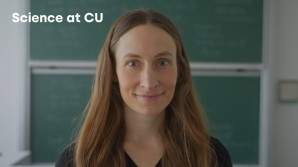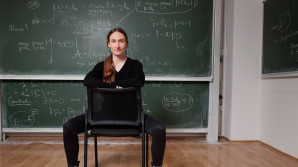


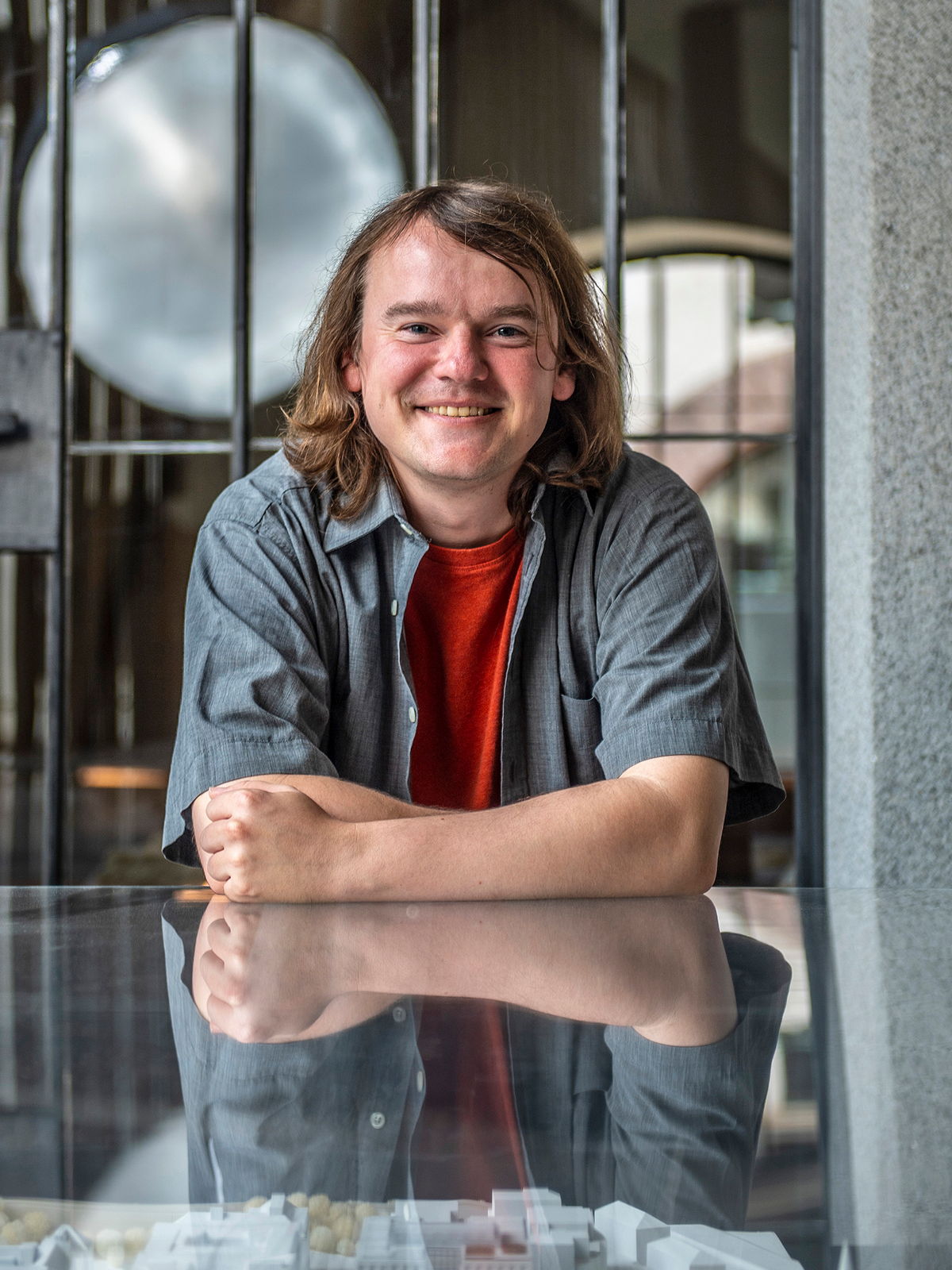
 New Jersey-born and currently Prague-based computer science theorist Ian Mertz sums up his research as a “counter-intuitive approach to using space that’s already full”. However, the approachable, cheerful postdoc and new ERC Starting grant holder clarifies he can’t help us find free space on our congested hard drives or even in cluttered cabinets. Still, his paradigm of reusing occupied memory space as a computational resource – called catalytic memory – might bring striking developments. As part of the Center for Foundations of Contemporary Computer Science at the Faculty of Mathematics and Physics, which he has chosen for its global reputation, he strives to redefine the notion of “full” memory and make it even more useful: along with holding data, it can also help with computing as an unexpectedly powerful resource – without erasing the original data.
How would you summarize your project Synthesizing Traditional and Reuse Approaches to Space, that was awarded the prestigious ERC grant?
Memory in computation, or, the amount of memory that a computer needs to perform a certain task, is a very traditional resource to study from a theoretical perspective, in order to optimize in a practical setting. Now, there is something we sort of have taken for granted ever since computers have been around, which is that as you fill up memory with data, you either use it for a certain task, or it is something that you’re storing for later. But if you want to then do something else, you sort of put this memory aside, and maybe come back to it later when it becomes relevant again. And this other work you do in more memory you allocate for your current process.
What we have only started to understand in the last ten years or so and what has become a huge point of research and discussion even more recently, and what this project focuses on, is that actually the memory that is being used for storage, or an unrelated task, is in fact not useless. So actually, even though storage memory in a computer might be completely full of unrelated data, it can still be an important resource in computation. And it is counter-intuitive enough that it’s almost not surprising it took us this long to even think about. But now that we understand it, we’re finding more and more situations where this can be useful, where you don’t need to set aside a whole new block of memory just because you’ve run out of ‘pure’ memory. You could use this ‘impure’ memory and still get the job done. I would even say that in the past maybe seven or eight months, we started to realize that these algorithms don’t ‘just’ exist, but that they can actually be reasonably efficient and possibly even practical.
And because this approach is so different from how we normally think about using memory in computation, we’ve developed a whole new suite of techniques that are used that are very specific to this idea of using memory that’s already full – and, needless to say, without erasing the data.
At first glance, with you making sense of full space, one might get the impression you can help people with their full hard drive or apartment full of things and find some free space. I am kidding, of course, but rather than freeing up full space, you actually make use of what is there already to do a certain task, correct?
Oh, there are many jokes we make ourselves. I make the jokes sometimes, too. But actually, we have to work under the assumption that you really can’t squeeze a single drop of additional free memory out of a full space. You have to truly work with whatever you’re given. And that leads to some very counter-intuitive ways of using it, but that’s the name of the game.
“Even though storage memory in a computer might be completely full of unrelated data, it can still be an important resource in computation. And it is counter-intuitive enough that it’s almost not surprising it took us this long to even think about.”
Could your theoretical findings or algorithms bring about breakthroughs in memory hardware, too?
I haven’t thought about this too much. It is true that for a lot of major developments in computation in terms of software, it also demands a certain hardware – or rather, certain hardware works better for it. One example would be artificial intelligence which seems to work best on massively distributed processors like graphics cards.
There are a lot of nuances in working with memory – there’s memory that’s really efficient, but very small. Then, a step down this hierarchy, it gets bigger, but also harder to access, meaning moving things around is less efficient. So, there is definitely a question of if these techniques may require accessing your memory differently than a standard algorithm, and in turn asking different hardware of it.
In order to actually want to use it in practice, it comes down to the gains that we get from this, and whether memory is such a concern that we would want to use these sorts of techniques for this application, even at the cost of needing different hardware or working slightly less efficiently with regards to time. And this I simply don’t know. But part of the project and like one of the parts of the project that I'm interested in is asking people who actually work on these kinds of questions what would be on their wish list and engaging with them, too.
There is also the not insignificant difference between memory (like RAM) and storage (usually a hard drive), with different utilisations, right? Many people might not think about it until they choose or build a computer. Is this dichotomy relevant for your research?
Yes, there is a huge difference. But from the theoretical side of things, I would say we don’t really touch on this. In fact, we’re actually quite flippant with saying, “I’m going to give you a full hard drive which you can use for your computation.” And of course, any practitioner would tear their hair out (laughs). Why would you ever use a hard drive to do your computations, right? So I admit we’re pretty disconnected from this.
But there are questions that I want to know, because RAM is where you usually do your computations, and it is also the thing that fills up more quickly than anything else. So, if this is usable in real time for these sorts of micro-computations, for sub-computations, for anything you want to do, then the structure of RAM makes a difference.
Again, as we start to tool things more towards actual usability or practical runtimes or whatever, we can go to the hardware people and say, hey, if I have an algorithm that works like this, can you use this? What would you need from us to change in order for it to be usable? And we work in these theoretical models where you assume that, you might have a full hard drive to use and your working memory is only this tiny RAM. And again, this would probably make them very irritated.
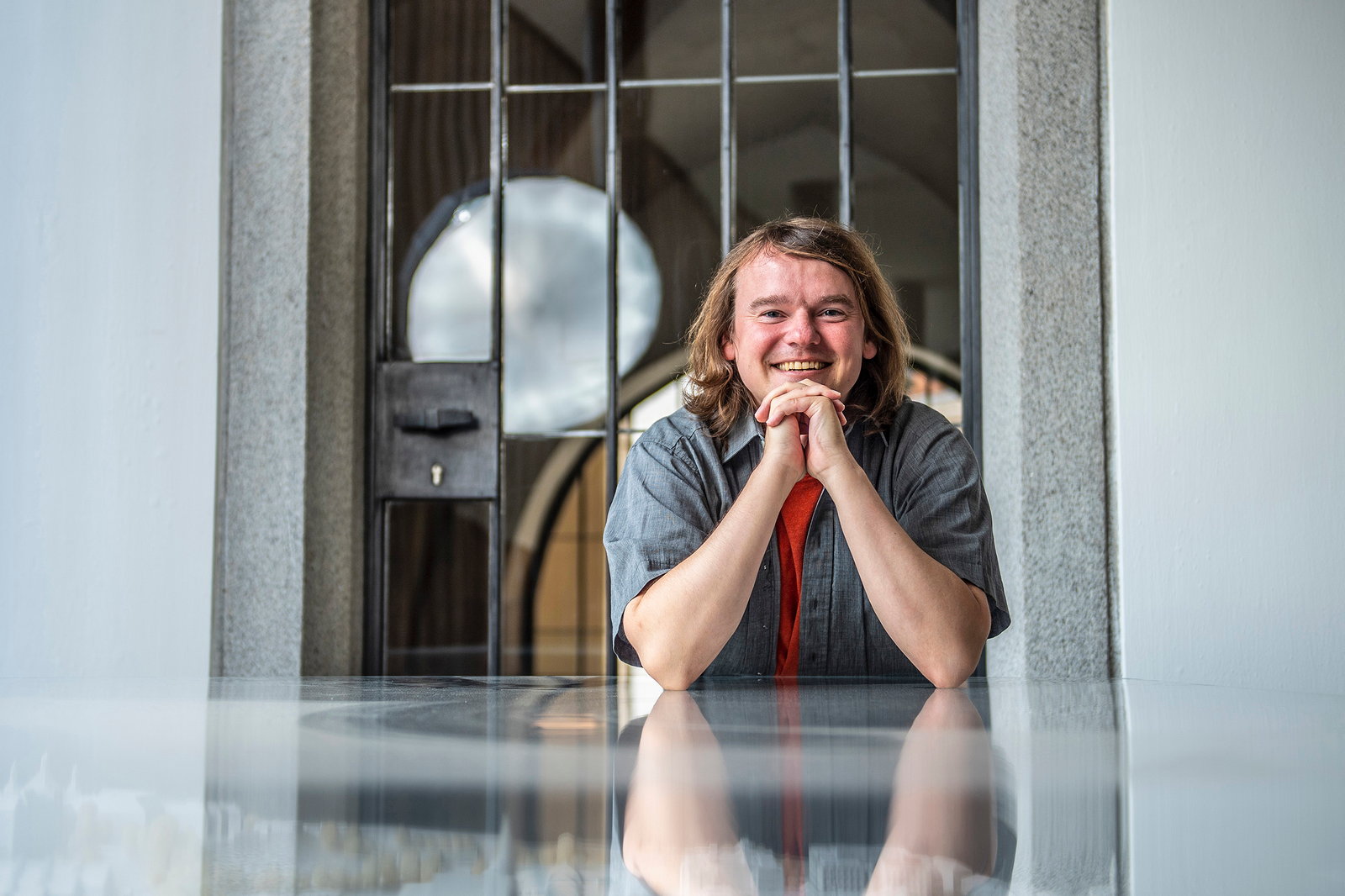
How would you describe your experience of applying for an ERC grant and going through the long process? This kind of large project is certainly intimidating, isn’t it? But you succeeded.
Obviously, at a baseline, it is just an intimidating thing to do – especially considering this was my first grant proposal. Also, I am a postdoc, which is not typical. We are certainly invited to give these proposals, but there’s a certain amount of ‘guts’ that you have to throw into it. Which leads into the second thing: the timeline on an ERC proposal is very different from the timelines for all other applications. By the time my interview happened for the second round, I would have had to decide about every other position whether or not I was taking it. The only reason I would have applied to anything else is applying to other positions in Europe where I could have taken the ERC. And I didn’t want to do that, I wanted to take it here. So, in the end, I took a leap of faith and this was the only thing I applied to this year. And if it hadn’t worked out, then next year I would have applied to everything but ERC (laughs).
It seems the word “faith” was important as well. It just had to work out…
Yeah, and again, this is a little bit atypical. I admit I’ve never been the best at doing the applications game. I’ve always applied a little too narrowly, but with this one, I’ve learned my lessons and I never wanted to do it like that again. In this process, the timeline was just so different that there was frankly no point doing anything else. I could have applied to other things, and then if I didn't get past the first round, then I pivot to that, and if I do, then I reject all of them. But that would be a lot of drain on everyone’s time and money.
Honestly, I kind of enjoyed the opportunity to really distil down my goals of the next five years, to sit down and say, how could I say this in the most succinct convincing way possible, just a road-map for what I want to research. It actually did help me focus down even what I started thinking about in the aftermath. Also the people here at Charles University, both in the department and in the directorate or whatnot, were extremely generous with their time and making sure everything was in order. Plus the mock interviews, seeing everyone from other fields really selling themselves. Especially the other person who won [researcher at CU ARTS and translator Petra Johana Poncarová – ed.], her interview was incredible. It was so cool to watch. I thought, “wow, so this is the kind of person who’s applying for an ERC”.
In the end, for all the stress of it, I really don’t mind having done it. I mind doing it, I don’t mind having done it.
How did you even find yourself here in Prague?
Actually, the story of why I ended up in the Czech Republic kind of dates back to the beginning of all of this, about fifteen years ago. The whole idea of where the project came from was proposed in a paper that came out in 2012, co-authored by my current advisor here at CU, Prof. Michal Koucký. His PhD advisor was my undergraduate advisor in New Jersey. Prof. Koucký then actually came back, visited his old PhD advisor and gave a talk at the seminar. I was a first year undergraduate when I saw it and thought this was completely nuts and the coolest thing I had ever seen. I then thought about it on and off for many, many years, but didn’t make much progress until 2019.
While I was in Canada, I ended up working on completely different stuff for my PhD. And then later there was a whole revival of interest in this topic. So suddenly, I shifted into it full time and started thinking about it. Meanwhile, the only person I know of from the original paper who’s thinking about this at all, and who I’ve had contact with, is Michal Koucký. I asked him to write me a recommendation letter for postdocs, and he said, sure, but of course, you can also just come here. So, after my first postdoc, I took him up on that and came here. And even in that short window of time, this field got exponentially more popular. Now, the two of us are riding at the top of the wave of something that’s now becoming very, very popular. The two of us work really well together.
“We’re actually quite flippant with saying, ‘I’m going to give you a full hard drive which you can use for your computation.’ And of course, any practitioner would tear their hair out!”
So, how does MathPhys live up to its overseas reputation?
When I first was in university in the United States, I didn’t really think about places outside the U.S. – we only hear about U.S. universities, maybe Oxford and Cambridge. But I applied to Toronto, which is this kind of place where when you go to Canada, everyone speaks about it with reference. And when I went there, I saw why. The work was really good. I realized just because a place doesn’t get talked about for U.S. undergraduate admissions doesn’t mean it’s not a world-class institution. And being here has been exactly the same experience. I can see why people, not just in the Czech Republic, but in surrounding countries, want to aim to be here.
Basically, if you were to go anywhere in the world and work on this stuff right now, it would absolutely be Charles University. There are some other obvious picks – a couple institutes in India that have quite developed groups on it, or MIT with a number of good people who are thinking about it. But overall, I would say it’s hard to argue against Charles as the place to be. And it’s a good working environment too. After two years, it was pretty clear in my mind that if I want to do good work in this area, why would I want to move out of here? This is exactly where I would want to be to do this kind of thing.
You surely also feel how important it is, even in this world of global cooperation and instant communication, to be present somewhere in person – in the flesh.
I just can’t do the Zoom meeting thing anymore (laughs). I completely burned out of it in the pandemic. Also, I haven’t really lived in one place all my life. I moved out of the U.S. to do my PhD, and then I did my first postdoc in England. I get the sense that most people either would like to kind of stay relatively local to where they are, or at least in the same country, and other people are comfortable moving out. And I’m just someone who’s been comfortable moving out, so there is no reason to pass up the opportunity to be. If I could be anywhere, why not choose the place where I can do the most by just going down the hallway and meeting face-to-face. Now, ironically, this field has taken off so much that I’ve been almost traveling completely non-stop to give talks (laughs). But now that I have an ERC and the field has become popular enough, I think I can sort of settle down a little bit and just focus on my work here.
In terms of living in the Czech Republic, how has your experience been?
I got lucky in this respect. There was another postdoc who moved here at the same time as me. We were postdocs together in England, so the two of us at least could be friends with each other, which was good initially. But then quickly we made friends with these grad students who also happened to be locals, and then met their friends and whatnot, and developed local connections.
The part I was worried about moving to the Czech Republic was the language. Obviously, English works fine, but you don’t want to make people speak English on their time off. But suddenly, all of us are friends, so I can go to them for Czech questions, but also to find things locally. And that's made the experience way better.
Of course, Prague is also just an enjoyable city to live in. You always worry when you move to a major city whether or not it supports locals and local life. But the infrastructure here with regards to public transit is very good. Everything is manageable in size while still being substantive enough. I live extremely close to multiple grocery stores, great cafés, there are many opportunities to meet locals and hang out, meet the foreign communities here, do volunteering and whatnot. It is exactly what I would want living in a city.
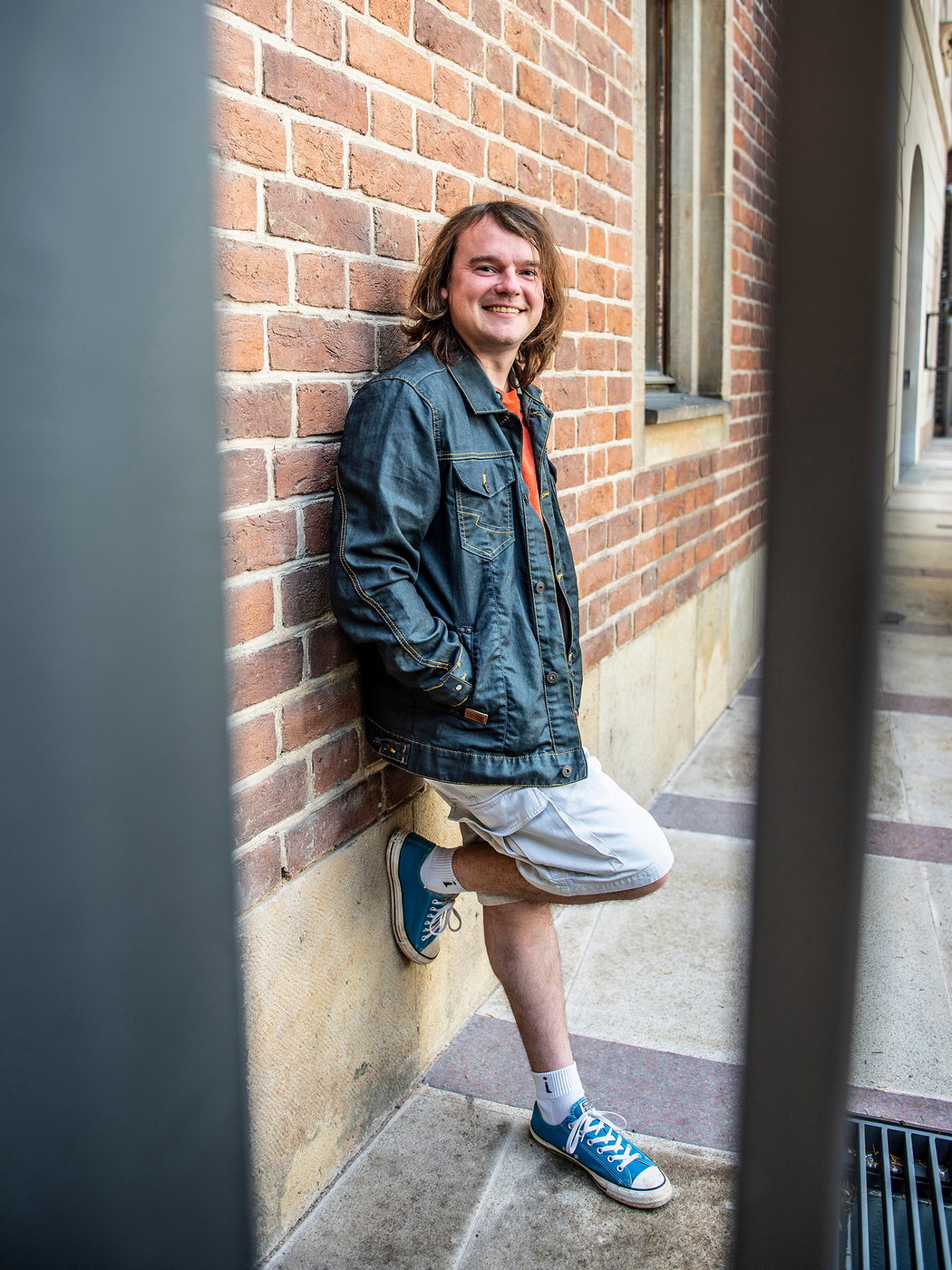 So, if you compare living in Prague to your past experience in the U.S. and elsewhere…
I come from Central New Jersey – I grew up most of my life in Princeton, of Princeton University fame, which is a great town with a very academic climate, small enough that everyone knows everyone. But as I went to undergraduate at New Brunswick, which was a city proper to some extent, I definitely developed a taste for living in more urban environments. And then Toronto was, of course, a major city. Then, for my first postdoc, I went to Coventry [at the University of Warwick – ed.], which is technically a city, but it was very hard to get places and it was small. I actually really liked the place, but I was itching for something a bit more substantive. And then coming here was really like, “yes, we’re back!”
Do you think the emerging and obviously quite different paradigm of quantum computing and quantum memory might change the fundamentals of the theoretical grasp of memory?
Well, it depends on what you mean by change, because in some sense we are understanding what to do in quantum things that we can’t do – or, at least, seemingly can’t do – in the classical world. Sometimes this even drives us to think about whether we can actually do it classically.
Actually, a lot of the people contributing to the first paper in this field were quantum people. One of the most fundamental things we know how to do using full memory as a computational resource is a type of computation we call reversible – you do something, you change the memory in a way, but in a way that can go back in reverse once everything is said and done. And quantum is inherently reversible in exactly the same way. The initial study of this process came out precisely of the understanding that quantum algorithms have some nice structure with regards to how they use space.
I have work from last year, but also an ongoing project with the quantum people at Oxford University and the University of Amsterdam, seeing whether we can assist in quantum computation with this. They have a lot more tools for us to use at our disposal, but they also care about memory so much more than the ‘classical’ people do. In quantum, even just adding one more bit to your memory requires grants much bigger than mine!
I am actually glad that you didn’t have a direct yes/no answer, but see it as finding a way together, which allows for more development and knowledge – rather than closing the door on classical computing, trying to find and refine the best of both worlds…
Theory is this amazing mosaic where if you ask a specialist in a different branch of theoretical computer science, their toolbox is so totally different than yours. There are questions you just take for granted are easy or even foundational, that they struggle and pit themselves against, and vice versa. And so, it’s always really fun to talk to the quantum people, the cryptography people, the people who care about data structures, distributed systems, et cetera. And everyone is just working with an entirely different paradigm. Of course, in a dream world, you can understand these and move between them and merge them. And some of the best computer scientists are exactly the people that can do this. But what I’ve learned is essentially you start with your own model, something you understand the best. And then you use that as your lens through which to understand these other things. So insofar as I understand quantum, I understand it pretty much exclusively through the lens of what I know how to do, because I don't really know another way to understand it. That’s human. There’s humility in it, I guess, but there has to be.
I will also say, it could be the case that quantum never comes to fruition in its truest form and it turns out too impractical or whatever. But for us theorists, that wouldn’t really matter because the kind of rich ideas that have come out of discussing this model on its own terms has changed the course of how we study a lot of other things. And so, again, a reason I really like this whole field is that there are no true dead-ends. Some things run aground and you can’t push them any further, or we realize they’ll never be implemented in the real world for one reason or another. But the ideas will always find another life somewhere else. So, I don’t think I’ll ever get bored of working in this field.
| Ian William Mertz, PhD |
| Postdoctoral researcher at the Center for Foundations of Contemporary Computer Science (CZSI) group at Charles University’s Faculty of Mathematics and Physics, where he collaborates with Prof. Michal Koucký. He has studied in his hometown at Rutgers University, New Brunswick, New Jersey and the University of Toronto, before working as postdoc at the University of Warwick (Coventry, U.K.). Since late 2024, he has been living in Prague. His research focuses on so-called catalytic computing – the study of using space that is already full. He has also published papers on composition theorems and space-bounded computation. In summer of 2026 Ian Mertz was awarded an ERC Starting grant for his project called STRAPS: Synthesizing Traditional and Reuse Approaches to Space. |