

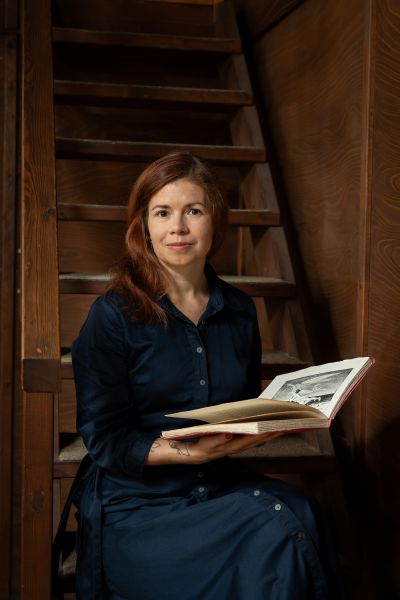
In her ERC Starting Grant, Petra Johana Poncarová will explore the phenomenon of authors who decided to learn Celtic languages in the nineteenth and early twentieth century and to use them for their creative work. A researcher from the Faculty of Arts, Charles University, Petra has been working on Scottish Gaelic literature for a number of years. She also writes her own acclaimed poetry in Gaelic. However, don’t come expecting Celtic mysticism from her.

How would you introduce your project NUDGERS: New Users of Minoritised Languages as Writers and Cultural Agents?
The project focuses on people who, in the nineteenth and early twentieth century, learnt one of the Celtic languages and then used it for their creative activities. Creative activity is meant in the broadest sense – for their own writing, translations, editorial work, and collecting folklore material. These people are quite numerous even in this early period, but in most cases very little research has been devoted to them individually, and no attempts have been made to study them comparatively and as a distinct phenomenon.
One such figure is Ruaraidh Erskine (1869–1960), whose work I examined during my time at the University of Glasgow as part of my Marie Curie Postdoctoral Fellowship. Erskine learnt Gaelic as a grown-up and went on to make a name for himself as a writer, translator and, above all, as a cultural organiser and editor. He founded several periodicals to provide other Gaelic writers with a new platform to publish their articles, poems, plays, and translations. Researching his magazines, I started to discover more people of similar ilk and realised that this was a trend, not a handful of isolated cases.
When I was thinking about what to do once my postdoc in Glasgow came to an end, I started to consider applying for an ERC Starting Grant. I originally started writing my application on a completely different topic, but I struggled with it for several months and in the end decided to postpone submitting it for a year. And on the same day when I gave up the fight, it suddenly dawned on me: the new users of Celtic languages in this early period would be an ideal topic. It was something I very much wanted to pursue and at the same time it fitted well with the requirements and priorities of the ERC.
How did the actual submission to the ERC go?
The Project Office at the Faculty of Arts was a great help, particularly Štěpánka Gray Marková, who is very experienced and kind, and she offers applicants real support tailored to their needs. She already has a number of other successful ERC applications to her name. It makes a huge difference when, as a researcher, you can focus primarily on the ideas and the content of the application and have someone at your disposal who understands the ERC processes. Without Štěpánka’s insights and the generous feedback from many colleagues in the field, I’m pretty sure I wouldn’t have been successful on my first attempt.
Will you be conducting the research yourself, or will it be a collaborative effort?
I will be leading the research myself, as the ERC Starting Grant is strongly focused on the principal investigator. However, I can recruit a small team, and I have already made tentative arrangements with three international colleagues who specialise in Cornish, Breton, and Manx – the languages in which I don’t have expertise. I very much look forward to working with them. I also plan to involve colleagues from the Centre of Irish Studies at the Faculty of Arts. At the same time, I would like to collaborate with selected universities in all the Celtic countries. However, Charles University will be the main recipient of the grant for the full five years.
You’ve been studying Gaelic for many years now. You even write your own poetry in the language. Why don’t you work in Czech instead? Do you find yourself thinking more in Gaelic these days?
When it comes to poetry, yes, I suppose so. I have translated a good deal from Gaelic, and academically, I write mostly about Gaelic literature, so I’m immersed in it much of the time. I feel that when ideas for poems arrive, they’re usually in Gaelic. I haven’t managed to do it in Czech yet. If I were to write poetry or fiction in Czech, I’d probably have to convince myself that I’m translating someone else’s work.
I talked about this with a colleague who is a native speaker of Gaelic but has chosen to write in English, and he told me that it suits him because it gives him more distance. What attracts me is that Gaelic is very rich, but it hasn’t been used as widely as English, where every new piece of writing may feel like a drop in the ocean. In Gaelic, you still have the opportunity to write about certain topics for the first time. For me, it’s a chance to have a creative outlet and to hide away a little, because the potential readership for poetry in Gaelic isn’t numerically very large, so it feels quite private, but meaningful.
How is your creative work perceived in Scotland? A writer from a foreign country bold enough to write poetry in the local language?
At first, I felt very self-conscious about how other people would take it, but the reactions have been positive so far. What’s more, I’m not the only one. Over the last fifty years, there has been a significant increase in the number of authors writing in Gaelic who learnt the language voluntarily, as adults. These include both Scots who didn’t grow up using Gaelic and people from elsewhere. For example, I have a dear colleague and friend from Germany, Michael Klevenhaus, who has published a novel in Gaelic and who is also a Gaelic teacher and a grammar expert. This has become an influential phenomenon in recent decades. In my experience, friends and colleagues who have Gaelic from the family seem to be pleased that somebody takes the trouble to learn their language and to write something new in it.
You’ve even been included in a guide to Scottish poets this year.
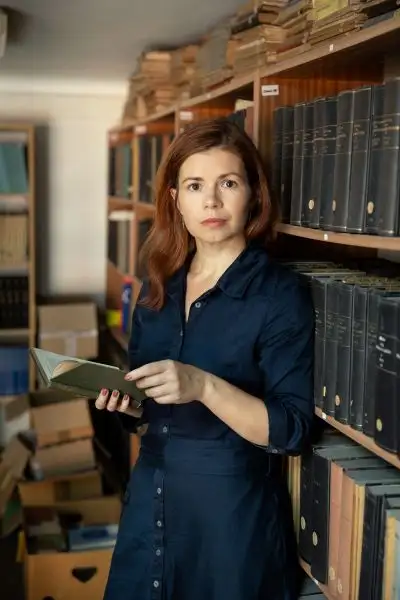 Yes. It’s thanks to my friend, the poet and translator Taylor Strickland, who nominated me. When the nomination got accepted, it was a great honour for me. By that point, I had been selected for the New Writers Awards programme, which is run every year by the Scottish Book Trust and the Gaelic Book Council. They offer grants to emerging writers who have already published their work in magazines but don’t have a full collection or novel to their name. It includes financial support as well as various opportunities to develop one’s writing. We attended workshops and went on a writing residency; each of us got paired with a more experienced mentor with whom we could discuss our work. For me, it was confirmation that someone found my literary efforts promising enough to support them in this way.
What do you write about in your poems?
I use poetry to reflect on my own situation, on living in different languages. What it means to learn Gaelic, to work in the language, to maintain personal relationships in it. I have a few close friends with whom I’ve never used much English. I’m delighted that I’ve been able to come this far, but at the same time I feel that I’m still at a disadvantage, because I don’t live there and spend my time writing or translating, rather than talking to people. Most of my conversations are with dead writers. To this day, I often feel that my Gaelic isn’t good enough, that I’m not trying sufficiently hard.
I enjoy looking for connections between the Czech environment and Gaelic Scotland, in places where nobody expects to find them. I come from North Bohemia, and I’ve written a Gaelic poem about the castle Jezeří, the demolished old town of Most, and the villages that had to make way for coal mining. In Gaelic, I was able to draw on local literature responding to the Highland Clearances. The events occurred in different eras and for different reasons, but the impact on the people and the landscape is in some ways similar. It’s my own North Bohemian ‘Waste Land’, only in Gaelic. Another poem was inspired by the paintings of Beneš Knüpfer, who is one of my favourite artists. Despite growing up in Prague, he became an expert on maritime subjects and settled in Italy. Gaelic has an abundance of specialised vocabulary concerning the sea and everything related to it, which offered me entirely new ways of writing about his paintings.
What is the situation of Gaelic nowadays? Is it a dying language, or is it thriving?
In some respects, it is thriving, and in others, it is dying out. The situation is mixed, because Gaelic now enjoys far greater official support than at any time in history, in terms of investments, public funding, media support, education… There’s still much room for improvement, but the support is unprecedented. At the same time, the numbers of traditional users have been declining decade after decade in areas where Gaelic has been spoken for centuries.
Scotland is a popular tourist destination, and in the Hebrides, with their stunning sceneries, land and property prices have risen alarmingly, as houses are used for short-term lets or maintained by people as holiday homes. This leads to further erosion of local communities, as people who would like to stay in these areas find that they can hardly afford to live there anymore. They decide to move elsewhere, and one of the effects is the weakening of the language.
On the other hand, the numbers of Gaelic speakers in cities are increasing, and there is also a steady rise in the number of people who have come to the language from outside and decided to learn it. It is a curious contrast. Ideally, it would be great to have both – traditional communities in good health, and a source of new impulses and reinforcements in the form of new users. There’s no easy recipe for reversing this decline, because English is omnipresent, and it can all too easily steamroll smaller languages.
In the Czech context, Celtic languages are often associated more with the distant past, with something mystical.
I think it’s important to emphasise that these languages have a long history, including a written one, not just an oral one, and that they represent an ancient intellectual tradition. You can discuss anything through the medium of Gaelic: you can write a biology textbook or a treatise on astronomy. I use Gaelic on WhatsApp and Messenger to talk about website design or about what I’ve just seen at the cinema. If people keep emphasising the mystical aspect shrouded in mist, in my opinion it holds these languages back.
It slips into something archaic.
Yes. Many of the writers I’m interested in and whose work I examine in my research certainly didn’t turn their backs on folk literature, on the contrary. However, it was important to them to demonstrate that Gaelic is an ancient language, yet at the same time a modern and flexible one. That they can publish entirely Gaelic newspapers and write about current events or translate Polish poetry – simply that Gaelic has a much broader scope.
Is that one of the reasons why you turned your attention to Derick Thomson, who played such a significant role in the development of Gaelic?
Yes, that was one of the reasons. When I first became interested in Gaelic literature, I was surprised to realise just how much basic research had not been carried out. Derick Thomson (1921–2012) made a significant contribution to Gaelic in a range of fields. Even if he had left behind nothing but his poetry, I’d say he’d still be remembered a hundred years from now, but on top of that, he spent fifty years editing Gairm, the single most important Gaelic literary magazine in the second half of the twentieth century. He was an influential academic who wrote books that remain indispensable in our field to this day.
I found it fascinating that someone managed to achieve all this, and to such a high standard. At the same time, I felt sorry that no dedicated scholarly book had been published about him, that no one had compiled his Gaelic prose. That is what I spent the first ten years or so of my career with, including my PhD (the monograph Derick Thomson and the Gaelic Revival was published in 2024, and An Staran, the anthology of Thomson’s Gaelic prose, in 2025, interviewer’s note). Given that Thomson always supported people who came to Gaelic from the outside, as learners, I thought to myself that he might have been pleased if he knew that the person who wrote the first dedicated monograph about him and edited his Gaelic prose came from Prague. That he might have been amused.
And what caught your attention about Ruaraidh Erskine?
Erskine is a fascinating eccentric character. I actually discovered him through Derick Thomson. I was going through Gairm, the magazine that Thomson founded, and in an early issue, I came across a short article featuring a photograph of a gentleman in his eighties, dressed in a tweed suit. In the article, Thomson and Finlay J. Macdonald, who co-founded Gairm, write that they recently paid a visit to an ‘old hero’ who had inspired them to launch their magazine. That’s when I sat up, as the name was new to me. Fortunately, I happened to be in Scotland, at the fantastic library of Sabhal Mòr Ostaig in Skye, so it was easy to find copies of the magazines Erskine edited in the early twentieth century.
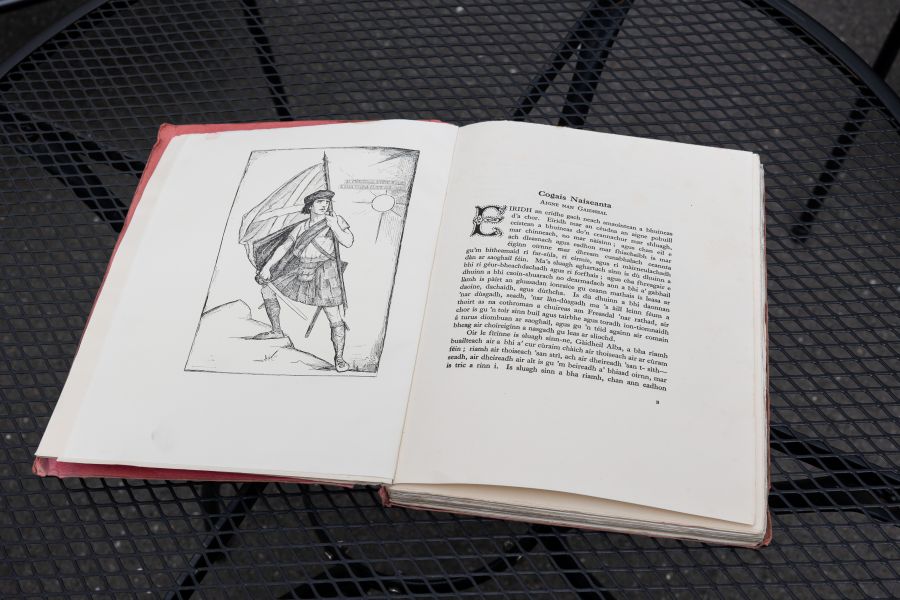
Erskine campaigned for Scottish independence and wanted to prove that Gaelic could become the official language of an independent Scotland. In this regard, he was keeping an eye on national revivals in Central and Eastern Europe: for example, he wrote an extensive Gaelic essay on the Czech national revival and Czech history, where he mentions Jan Hus, the Battle of White Mountain, and the policies of Maria Theresa. Among Erskine’s contributors was the Czech politician and diplomat František Lützow, whom he invited to explain to the Scots how the Czechs had managed their own cultural and linguistic revival and how smartly they had gone about it.
You also translate British authors, such as the anthology of ghost and horror stories by British and American women writers, More Deadly than the Male, or Algernon Blackwood’s novella The Willows.
Ghost stories are one of my great hobbies, both as a reader and as a translator. I also taught a seminar on this topic at the Faculty of Arts, and we’re running it again this winter term. The ghost story as a distinct literary genre that can be traced back to Walter Scott and other celebrated figures. A number of other Scots have contributed to this tradition, including my favourites R. L. Stevenson, Margaret Oliphant, and John Buchan.
We do not have such a strong tradition of ghost stories in Czech literature, although some writers, such as Jakub Arbes and Julius Zeyer, did experiment with similar genres. In the English-speaking world, however, literary ghost stories have a long pedigree, spanning both the British Isles and North America. I am currently translating another Blackwood for the independent Czech publishing house Medusa: Wendigo, the famous novella set in the Canadian wilderness.
You have also translated one entire book from Gaelic into Czech.
I decided to translate what is praised by many as the finest Gaelic novel, Deireadh an Fhoghair (The End of Autumn) from 1979. The author, Tormod Caimbeul, taught me for a while when I was doing a Gaelic course in Skye. The translation was published in 2018 by the Czech publishing house Argo under the title Konec podzimu, and I am still chuffed that this masterpiece of Gaelic prose is now available in two languages: in the original and in Czech. There is no English translation.
You are also involved in a literary agency, Zikmund Literary. What is your role there?
For me, the agency is mainly an exciting counterbalance to the academic and administrative work. It was founded by Jan Zikmund, my good friend and fellow English graduate of the Faculty of Arts, and I help him a little with communication, translations, and text selection. Individual publishing houses and several agents promote Czech literature abroad; however, many authors who have the potential to attract international interest have not been actively represented. I became involved in the agency through Jan and partly through the poet Petr Hruška, whom we twice hosted in Scotland during my stay in Glasgow. A wonderful connection emerged between the Czech and Scottish poetry scene. Petr Hruška befriended Scottish poets who took an immediate liking to him, and he on the other hand fell in love with Glasgow because it reminds him of his native Ostrava. I realised just how much I enjoy these opportunities to bring the two countries closer together. Thanks to the agency, we have now arranged for Petr’s acclaimed collection Spatřil jsem svou tvář (published in English as I Caught Sight of My Face) to be published in Scotland in my Gaelic translation. This will be the very first translation from Czech into Gaelic. I’ve already started working on it, and I’m really looking forward to presenting the book in Scotland.
I know you’ve spoken about this many times before, but what first attracted you to Scotland?
 In secondary school, I had a big dream of studying English at Charles University in Prague. In this regard, Professor Martin Hilský was a significant influence, because I loved his lectures and translations of Shakespeare. I was terrified I would fail the entrance exams, and I started cramming two years in advance. As part of that, it began to dawn on me that what in secondary school lessons was presented to us as ‘Britain’ consisted of different countries and regions, each with its own heritage languages and traditions – that it wasn’t just England and English. In the case of Scotland, I first got interested in individual authors such as R. L. Stevenson, who wrote mainly in English and partly in Scots. Scots is Scotland’s other minoritised language, closely related to English but with its own literary and cultural tradition and a great diversity of dialects.
Scots is what I initially wanted to learn myself, but in 2008 in Prague, I couldn’t get hold of a textbook and I didn’t find much in the way of online resources. I figured that I probably wouldn’t get very far there, but it occurred to me that there was another language in Scotland – Gaelic. On my first trip to Scotland, I bought a textbook, Teach Yourself Gaelic. At first, it was more of an unusual hobby. It changed into a serious interest thanks to Professor Martin Procházka, with whom I had already collaborated on various projects as a student and who later supervised both my MA thesis and my PhD dissertation. One day, he brought me a copy of the famous anthology of modern Gaelic poetry, Nua-bhàrdachd Ghàidhlig. And that book set off my entire career.
In it, I first discovered Derick Thomson, Sorley MacLean, and other writers. Their poetry really captured my interest, I cannot quite explain why in rational terms. At the same time, it struck me as a promising field of research, given that nobody was working on the Gaelic language: not at the department, not at the faculty, not at the university, nor anywhere else in the Czech Republic. For someone with my temperament, this was more appealing than the prospect of getting involved in some large, already well-established and thoroughly researched field. I don’t mean any disrespect to those areas, but personally I’ve always enjoyed the idea that I could do something that would be new and interesting also in the original country, not just in the Czech Republic. And that’s how it all began.
Over the years, you’ve been to Scotland many times and visit regularly. Which place is particularly close to your heart?
That would be Raasay, an island in the Inner Hebrides which still isn’t overrun by tourists. It is a little island wedged between Skye and the Scottish mainland, and it offers stunning views of both. Raasay is the birthplace of Sorley MacLean, the most significant modern Gaelic poet, and I first went there mainly because of him. Then I came to love the island for its own sake. It has a bit of everything – there’s an Iron Age fort, a Pictish stone, a medieval castle, a tidal island… And then there are places that are interesting for very tragic reasons – ruined townships whose inhabitants were cleared in the nineteenth century. Sorley MacLean writes about these places in some of his most famous poems, which I’d like to translate into Czech one day. I always want to go back to Raasay.
| Petra Johana Poncarová |
| Researcher and translator based at the Faculty of Arts, Charles University. Between 2023 and 2025, she held a prestigious Marie Curie Postdoctoral Fellowship at the University of Glasgow, where she carried out a project exploring the periodicals founded by the Scottish nationalist and author Ruaraidh Erskine. Her research focuses on twentieth-century Gaelic literature. She translates from Gaelic and English into Czech and is the author of the monograph Derick Thomson and the Gaelic Revival. She promotes Scottish culture in the Czech Republic and writes her own poetry in Gaelic. |