

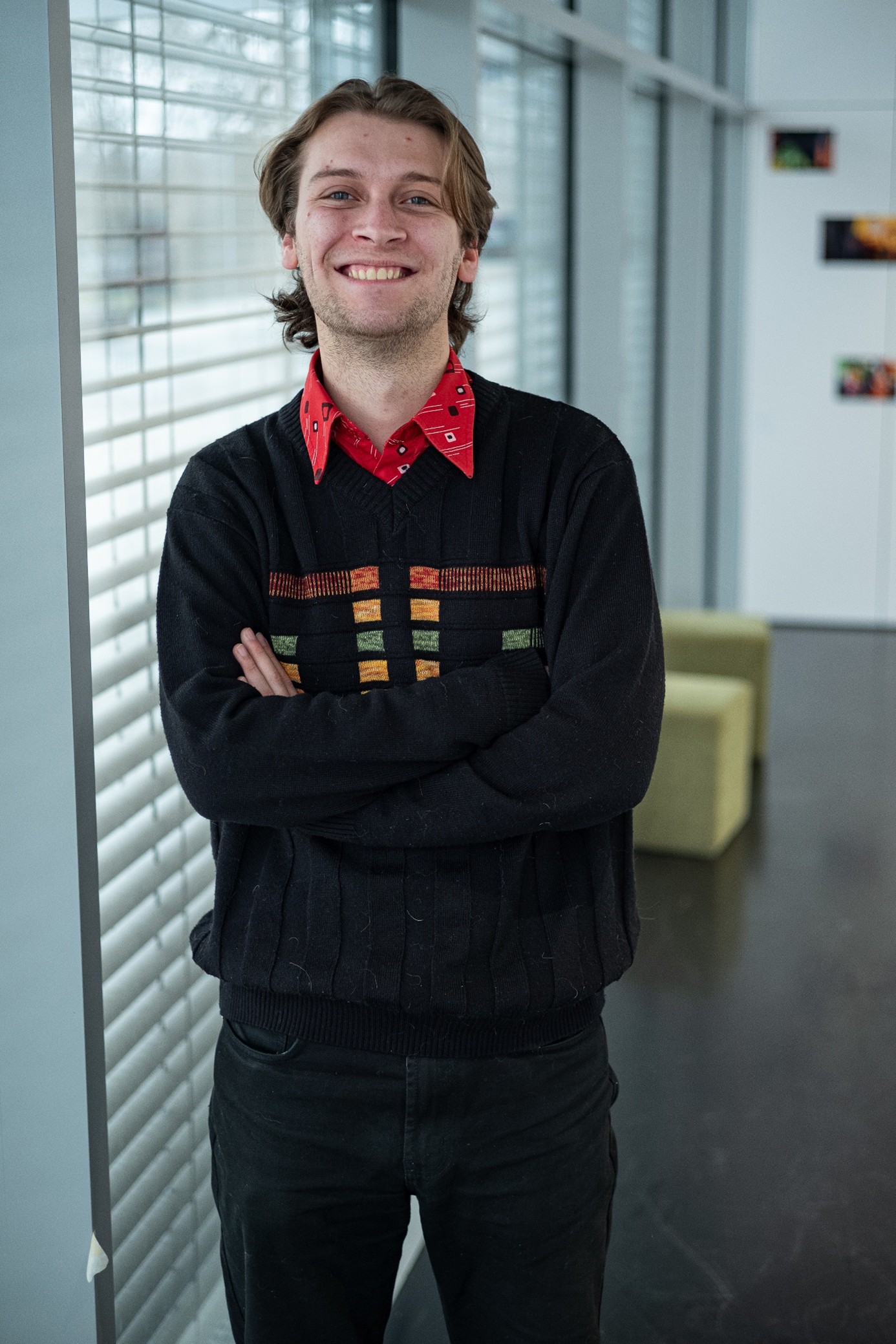
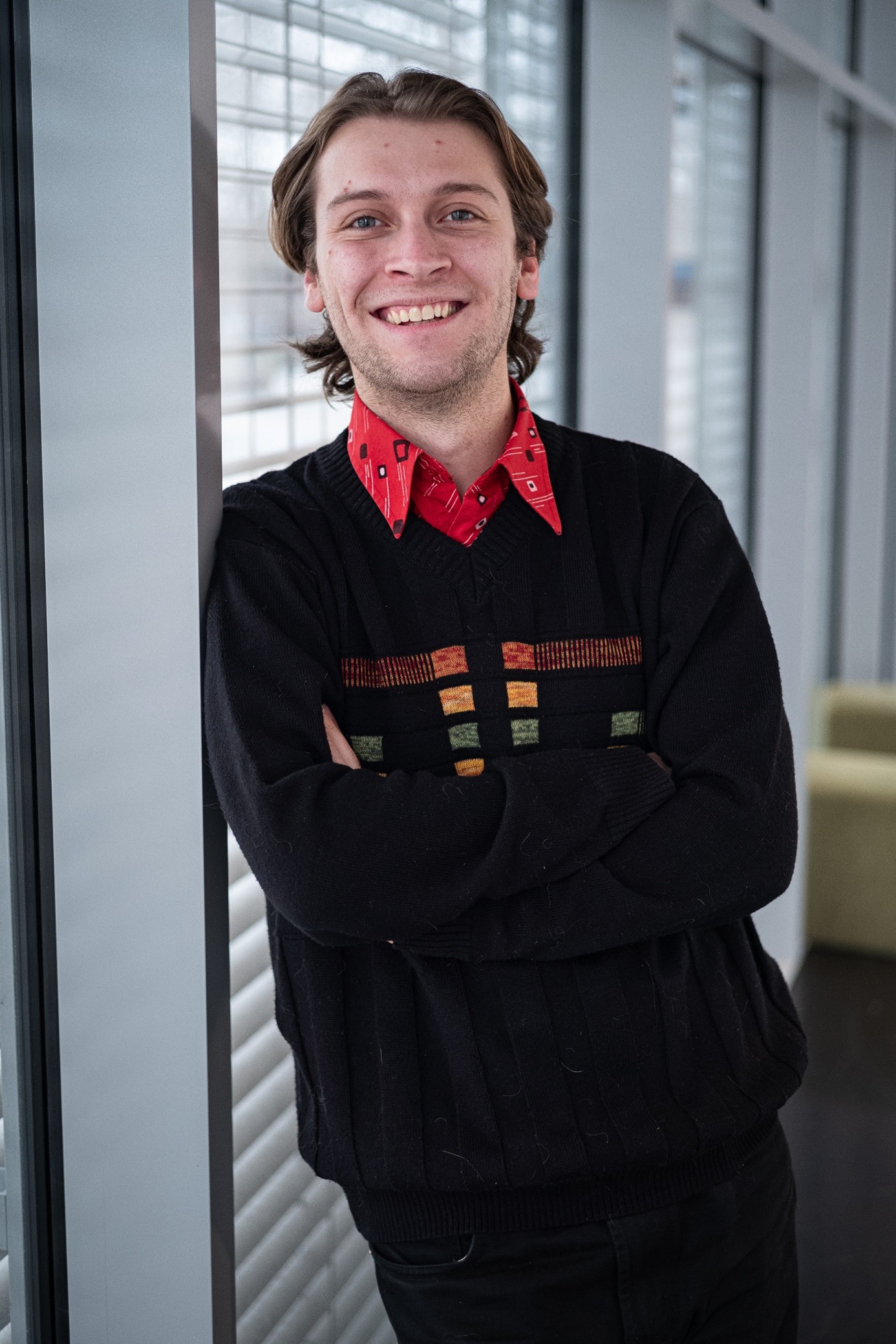
Justin Douglas Hart is a student of the Liberal Arts and Humanities bachelor’s programme at the Faculty of Humanities, Charles University, and the recipient of the Miroslav Vlček Exceptional Scholarship – a prestigious award granted by the Study in Prague Consortium to students who make an outstanding contribution to the international community. Recognised for his exceptional support of international students, his active involvement in student life, and his long term engagement as an awarded student ambassador, Justin has become an important part of the CU HUM community. Alongside his studies, he also connects his personal experience as an expat with his academic interests: in his bachelor’s thesis, he explores transcultural teaching among international educators in Prague. In this interview, he reflects on his academic journey, community work, and how the faculty and CU has shaped his path.
What did receiving the special scholarship and the ceremony mean to you?
Honestly, it wasn’t something I expected, so the first word that comes to mind is surprised. I was told that I had been nominated a few weeks before the actual ceremony, and then I was also told that I had won, so of course I was excited. I felt honoured to receive this award – and still a bit surprised.
A part of me definitely doubts whether someone like me should receive this award. There are so many great candidates at Charles University; I think two PhD students were also nominated, so I was very honoured to be the one who received it.
The ceremony was wonderful, and it was really meaningful to have everyone there who has been part of my academic journey. My parents were there, as well as my thesis supervisor Veronika Čapská, who was also representing the Faculty of Humanities. And of course, everyone from the Charles University ambassador team. It felt great to be able to show them my appreciation and to express my gratitude to the people who have helped me along the way.
In your view, what is the significance of recognising student engagement through a special scholarship?
I think it is important for international students to be recognised for their academic achievements. In the Czech Republic, there are many awards and scholarships for Czech students, and I think it is also easier for them to be awarded or honoured in certain ways simply because of the natural infrastructure within academia. So, I believe it is really beneficial to acknowledge that there are non‑Czech speakers in this country who can also contribute.
How did you become a student of the Faculty of Humanities, and why did you choose it for your studies?
It’s a long story. I actually grew up in the Czech Republic – I moved here in 2012. I attended middle school and high school here, although we also had a brief stay in Morocco, which interrupted my time in Prague. But after I graduated, I felt a strong connection to the city. I really loved Prague, and I decided to stay and continue my higher education here.
I originally enrolled at a different private university, but I didn’t find it very fulfilling. So, I started exploring other options, and after a year there, I applied to Charles University – and I got in.
And why the Faculty of Humanities specifically? I’ve always loved everything related to the liberal arts. I’ve always loved history; it was my favourite subject in high school. I didn’t know much about anthropology at the time – I think not many high school students do – but I definitely developed an appreciation for it later. I really wanted to see how different fields interconnect.
What personally motivated you to dedicate your time and energy to supporting the integration of international students?
I started during the COVID pandemic, a time when students – especially international students – were very isolated. So, when things began to open up again, I wanted to see what I could do to help rebuild a sense of community after almost two years of studying with very little in‑person contact. That was really what motivated me to get involved in the ambassador program.
Among my friends, I have a reputation for being something like an event planner – an organiser who brings people together – and I was finally able to put that into practice after I was selected as an ambassador, which I think was three or maybe four years ago. But things really started to take off about two years ago, when we began hosting regular events and actively trying to bridge the divide between different faculties. That was one of the main missions of the ambassador program.
CU HUM is one of the smallest faculties at Charles University, which also means we have a very small number of English‑speaking students. So as an HUM student, I felt it was important to connect with others – with the larger international student community at Charles University – and to create opportunities for conversations across different fields.
What do you think are the strongest aspects of the Faculty of Humanities when it comes to working with international students?
I really appreciated how the professors facilitated dialogue in class, making sure our conversations were open and honest – which can be quite difficult and challenging when you’re working with international students who bring a wide variety of perspectives. I truly valued their ability to create and support a sense of community both inside and outside the classroom.
There is also the international student association here, and I really appreciated how the faculty brought together such a diverse group of people to learn from one another.
How important do you think the role of student ambassadors is for the faculties?
Student ambassadors play a very important role – one that the university itself often cannot fully fulfil. I think students are more likely to trust ambassadors because we are one of them and part of the student body. So, if there are issues, or if events are being planned, students feel more connected to it. It feels less commercial and less about PR or marketing, and that’s exactly where student ambassadors come in. Their work is really important for the overall well‑being of the student community.
Can you give a specific example of a situation where the faculty’s support helped turn a good idea into a real project?
I have a friend who is now also a fellow ambassador – her name is Masha. She’s a very good friend of mine, and while I wasn’t directly involved in this particular project, I know that she successfully created the international student group I mentioned earlier. It has been wonderful to see it take off, especially as someone who didn’t have anything like that when I first came to university.
This kind of initiative creates space for students to develop their own projects, which can sometimes be difficult to do alone. It brings me a lot of comfort knowing that students now have that support system – that they’ll have people they can reach out to, especially during their first year, which can be quite overwhelming for international students. I saw the faculty really help build and support that group, and I think that’s a great thing.
How important do you think initiatives that come directly from students are?
I think they are the first line of defence against almost anything that can happen. They’re the first source of support when you’re going through a crisis – or even when it’s not a crisis and you simply need some help. The first step is usually to go to a friend, and it can be really difficult when you don’t have that network. That’s really what the ambassador project is about: filling in that community and making sure people have friends to turn to if they need further support.
Charles University and the faculty can provide help, of course, but just like in any regular friendship, you always go to your peers first – and that’s what this is about. I don’t consider myself a mentor; for me, it’s about bringing people together and letting things develop naturally.
What do you think makes the Faculty of Humanities a place where students are not afraid to be active and engaged?
I think it’s quite a progressive environment, but when you’re working with international students, it’s especially important to create a space that is welcoming to all viewpoints and to people from different political backgrounds. I think the faculty and the professors do a very good job of being sensitive where they need to be.
Take the Christmas tree, for example. I was looking at some of the ornaments made by students, and you could see so many different perspectives represented – so many signs of support and solidarity with various causes. I think that’s something unique to the Faculty of Humanities. I can certainly say that CU HUM has done a great job of making sure people feel heard and that their perspectives can be seen.
Which specific activities for international students do you consider the most beneficial?
I would say study groups. I’m talking about finding a café in the city and working on a shared project or bouncing ideas back and forth. I think that’s something essential – something most students find genuinely beneficial.
But there are also activities outside academics that are just as important, like pub quizzes. I’ve hosted a lot of karaoke nights as well, so I think cultural events are really valuable for continuing to learn about the many colours of Charles University.
What skills did you gain through working with the international student community?
Oh, many! I can start with learning how to interact with people again, especially after a period of limited contact with the outside world during the COVID pandemic. I think I’ve really learned to listen to people’s stories and to take a genuine interest in the backgrounds of international students. I’ve become an active listener – someone who truly enjoys hearing about why they chose this program or that program, where they come from, and what their journey here was like.
All of these stories are fascinating to me in a way they weren’t before. And as an American – where we are quite privileged – it can be eye‑opening to hear about the challenges many students face just to get here, as well as the difficulties they share once they arrive.
I think being a good listener is a critical competency that I’ve definitely been developing over the past two years, both through my experience at the faculty and through the ambassador program. I’ve also seen how invaluable this skill is in the workplace; it really helps with basic human connection. I’m sure there are more skills I’ve gained, but this is the first one that comes to mind.
 In what ways did your studies help you develop your organisational and communication skills?
I would say especially through anthropology. I think I’ve learned how to communicate thoughtfully and sensitively – it’s important to meet people where they are. Sometimes I come across posts or comments that sound a bit aggressive or unintentionally insensitive toward different groups, including marginalised communities. Having an awareness of the world we live in, and of the cultural and definitely multicultural environment around us, has helped me not only communicate better but also create posts and messages more responsibly.
Which experiences from your studies do you consider essential for your future professional path?
I think a lot of it comes down to the conversations we had in class – the discussions facilitated by professors about difficult topics that really made you think. The debates, the exchange of perspectives, and the chance to hear how others approach the same issue were incredibly valuable.
Since I want to go into teaching, I’ve found it especially important to learn how to facilitate discussions and create an environment that is aware of its cultural context. That’s a crucial skill, and one that will definitely help me in the future. I’ve also learned how to engage in that environment from the other side – not only how to facilitate, but also how to participate in a productive and meaningful way.
What did your studies give you beyond academic knowledge?
You become part of a community. I know some friends who graduated a year or two ago and now have very few friendships left – or their university friendships simply faded over time. But that hasn’t really happened to me. I feel that the friendships I made here have truly lasted, and I think that’s a testament to the faculty and the kind of people it attracts.
People here manage boundaries well, they don’t keep their guard up, and they seem genuinely themselves – especially within the CU HUM student body. That’s something I’ve experienced personally, and something I think will stay with me for a long time. Lifelong friends, I suppose, if you want a term for it.
What did you enjoy most about studying at the Faculty of Humanities?
I really love the anticipatory approach within anthropology, but also the way you work across other social sciences. I found it very fulfilling to begin seeing the connections between different fields. That’s obviously part of the whole process – it’s the point of this degree – but it’s not something you get in your first year. It’s something that comes in the second and third year, when you can start drawing on different theories and begin to see these connections in a way that many disciplines struggle to achieve. That was definitely a highlight for me: seeing how each field influences the others.
What is the name of the teacher who made the strongest impression on you?
It’s got to be Veronika Čapská. I took her class on gift exchange, and I really didn’t know what to expect. I had a couple of friends who recommended it, and I thought, well, gift exchange – how much can there be to say about gifts? But I ended up absolutely loving the class. We dug deep into the topic and learned how gift exchange is fundamental to so many different people around the world.
I think it was partly the content, but also her as a professor and as a person – the way she engages with students and manages the class. She’s very relaxed and calm, and the way she presents information creates a very welcoming environment.
I also really enjoyed Professor Adam Colman’s classes. He taught a couple of master’s courses, and I had a lot of respect for his teaching style and the way he approached the material.
Students and graduates of the Faculty of Humanities are often socially engaged and care deeply about what is happening in society. Why do you think that is?
I think some students come from marginalised groups themselves, and when they’re here, they learn about other struggles – sometimes even shared struggles they can identify with. That can definitely play a role. I also think the curriculum highlights many global issues that have existed for decades or even centuries and learning about these injustices can be quite radicalising. It opens your eyes. And honestly, I think people here just have a heart. I really do.
Do you think the faculty environment and the study of the humanities encourage openness, empathy and sensitivity in students? And do you see that in yourself?
Oh, absolutely, for sure! Compared to some other social sciences, the humanities focus on stories rather than statistics. We don’t just look at what works – we look at how things affect people. We look at the human side of the numbers. We learn to think critically, to listen to people’s experiences, even when they don’t have much of a voice.
That’s especially true in anthropology, where identity, stories, and fieldwork are central. Going out, doing your own research, having conversations with people who have been affected by different groups, by governments – you name it – all of that is rooted in human connection and human emotion. Seeing that and feeling that in person is integral to the liberal arts.
The physical environment of the faculty also plays a role. We’re in one building, which creates a small, close-knit community. You run into people, you run into professors, you talk on the way to class. It feels intimate in a way that larger faculties don’t. I hesitate to use the word “family” because it sounds so corporate, but in many ways it is – especially within the international student body, simply because we’re such a small group.
In your view, how does the Faculty of Humanities prepare students for working in an international and culturally diverse world?
This is a question I’ve thought about a lot since entering the workplace about two and a half years ago. Many people aren’t always sure how to translate a liberal arts or humanities degree into a career path – it’s not business, economics, or statistics. There can be a lot of anxiety around what comes next: Do I need to continue my studies? Do I need a master’s in media? A doctorate? I think many students feel pressure to stay in academia, but that’s really not the only option.
I have friends who now work in the corporate world, especially in HR, after completing their liberal arts degree. That’s not necessarily my path – I chose teaching at an international school – but I think our studies prepare us well for multicultural environments. In my work at the school, I’ve found it incredibly valuable to come from this background. Another friend of mine also works in education, and I think that anything involving human interaction across different cultural backgrounds is a very natural direction for many of us.
Did studying at a faculty with a strong focus on reading and writing change your relationship to text in any way?
Yes, for sure. What I will say is – it’s university, so it’s always going to feel overwhelming at times. I definitely needed a bit of a break after finishing my compulsory classes. But once you step back and reflect on your studies, you realise what you actually miss.
There are pieces of literature and academic texts I never would have read anywhere else, and now I can see the connections between them. And importantly, when I read an article today, I can relate it to something I encountered during my time at university. That’s invaluable – especially the reading element. It really opens up a different world: a different perspective, a different way of reading, and a different way of connecting texts with one another.
Are there any books that you read at the Faculty of Humanities that stayed with you or that you still keep on your shelf?
I do – I keep all of the books on my shelf. I have everything from Plato to Aristotle. And if I had to pick one that really stayed with me, it would be The Republic. I don’t even know why exactly – I just found it fun to read and fun to critique. I enjoyed the political dimension of it as well. Even though I studied liberal arts and humanities, my second choice was actually to study Politics, Philosophy and Economics at the Faculty of Social Sciences. So, I’ve always liked that mix of philosophy, sociology, history and politics.
How would you describe the Faculty of Humanities to someone who has never heard of it?
I would say it’s a very welcoming and fresh environment. People should know that it’s a growing faculty – it’s developing, expanding, and constantly bringing in new professors and guest lecturers, which I think is really important. I love the café, and I love the student body.