


Ever since she was a little girl, she knew she wanted to be a pastor, or ‘at least’ a teacher. Today, Eliška Vančová wears a robe at the parish in Heřmanův Městec, while simultaneously working on her doctorate at the Protestant Theological Faculty of Charles University. In her free time, she paints and watches science fiction films. Thanks in part to her efforts, the Protestant Church has reevaluated its approach to the LGBTQ+ community.
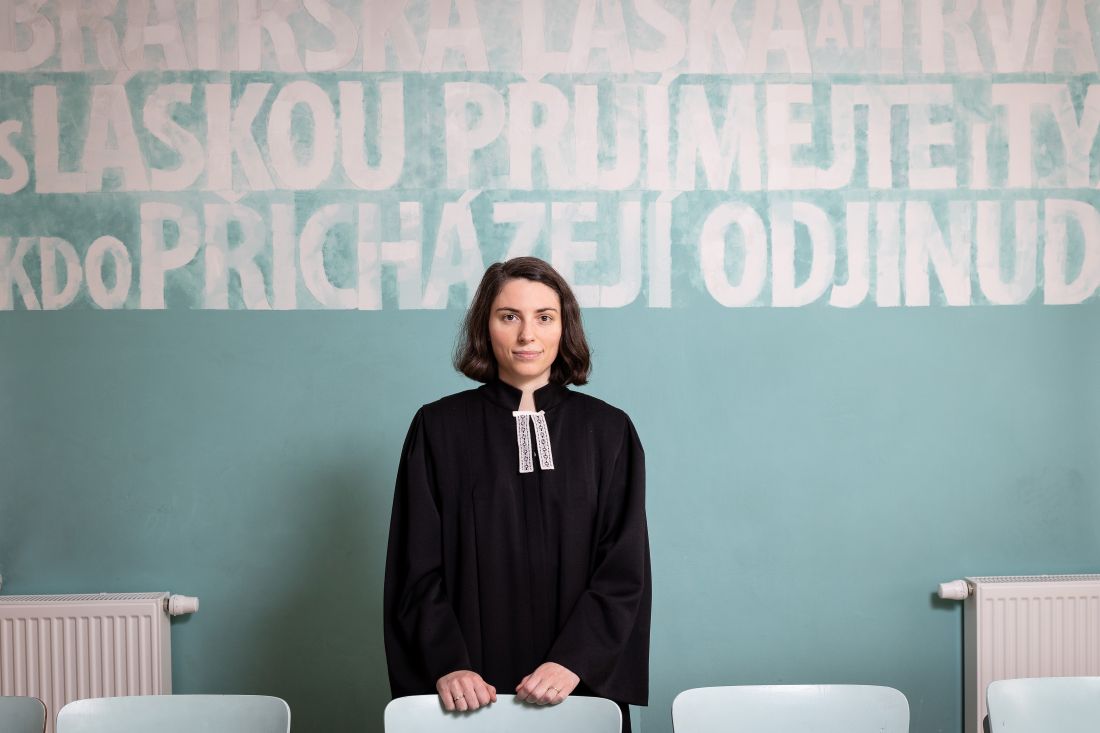
You have been a pastor with your own congregation for a relatively short time. Was there anything that surprised you at the beginning of this vocation?
I wouldn’t really say surprised. From my studies and a year of practical training called the vicariate, I felt that I knew quite well ‘how it’s done’; church services, catechesis for children, pastoral conversations… But then a lot of administrative work comes into play, which fortunately is the responsibility of my colleague, but still, you have to deal with or decide on matters related to finances and property management and so on. Your studies prepare you to be a theologian, but not specifically to be a pastor in a congregation; that’s something a little different.
Did you decide during your studies whether to become a theologian or a pastor?
I went to study to become a pastor; the whole time, it was about wanting to go into ministry. My ideas about what that meant certainly changed, but what didn’t change was that it’s what makes sense for me to do. But I enjoy studying, which is why I’m now pursuing a doctorate.
I come from a congregation in Hradiště, which is a village not far from here, and there was a male and a female pastor there. I really liked the fact that they did spiritual work and spent time with people at the same time. And when I saw that women could do it too, I thought I would like to do it as well. So ever since I was little, the first profession I wanted to pursue was that of a pastor. Then I gave up on it for quite a long time and wanted to be more ‘normal.’ But I returned to the idea of becoming a pastor sometime towards the end of high school, and since then it has always seemed like a good idea to me (smiles).
When you wanted to be ‘normal,’ what did you consider?
Being a teacher. I enjoy languages, so I considered teaching English or French. I enjoy working with words and people.
Are you still involved with languages in your free time?
French is now one of my exams in a second language as part of my doctoral studies. And a lot of the literature is in English, and communication in the European ecumenical field is also in English, so in that sense, yes. But I wouldn't say that I'm specifically educating myself further.
Is there a history of priesthood in your family?
A little. My dad studied Catholic theology and was then ordained as a minister in the Evangelical Church of the Czech Brethren (ECCB), and now he is an assistant preacher. This means that he has a civilian job and occasionally gets invited to perform ordained services.
Your father went from being a Catholic to a Protestant?
Simply put – dad led my mom to faith, and mom reformed him. (laughter) Of course, it was a joint decision when they met. Dad was a little disappointed with the Catholic seminary, and then it made more sense for them to be together at the Evangelicals.
And was it he who encouraged you to pursue your dream of becoming a pastor?
No, that was purely my decision. Perhaps partly because my dad didn’t choose that path and ended up pursuing an academic career. And I would say he’s happier with that than he would have been as a pastor. It was never something that was expected of me, or something my parents guided me toward.
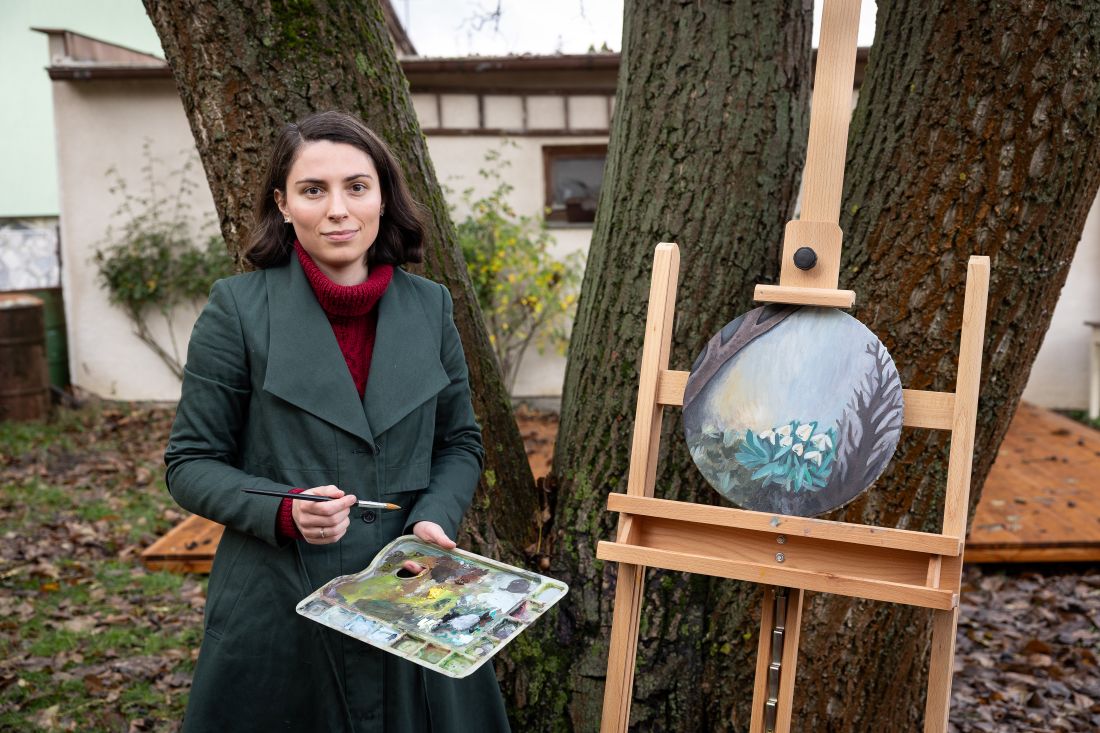
In her free time, Eliška Vančová likes to paint.
Did you know the community in Heřmanův Městec before you started?
I was here for the first time only when I started, even though I come from Chrudim, which is just a fifteen-minute drive away. But I guess that’s how it usually is when you live in a bigger city, you tend to know the surrounding areas as places you pass through unless you actually need something there. So I knew that Heřmanův Městec exists, and I knew the children of my predecessor’s pastor family because we knew each other from the Evangelical youth group, but otherwise it was new to me.
It wasn’t like I grew up here or in Chrudim and then started working here as a pastor. And actually, I didn’t really want it that way, because I think it would have been more complicated for me as a young girl. Even so, I hesitated, wondering if it wasn’t too close, but then I decided that it could actually work. And I’d say it seems to be working.
How did they accept you, a ‘young girl’? Female pastors are not unusual in the Evangelical Church, but did you encounter any prejudice?
During interviews with different congregations, I sometimes encountered the idea that their ideal candidate would be a young pastor with a family. They simply assume that the likelihood of him taking parental leave is lower than that of a woman. The congregation hopes to have children, but at the same time they want a pastor who will not be on parental leave.
Nowadays, men can take parental leave too.
Yes, and I think that this is often the case in our church, because the pastor is usually the one with the lower income in the couple. By the way, Chrudim was the only place where they didn’t ask me when and if I was going to have children. I actually liked that it didn’t matter to them, or at least they didn’t make it an issue. Of course, the topic comes up in pastoral ministry, and it always affects women, but it doesn’t have to be just about them. More and more men are taking parental leave, at least for a while.
You are married; have you resolved this issue at home?
Yeah, I’d say so. (laughs)
Is your husband also active in the church?
He is the son of a pastor, and we have known each other since we were young. The fact that he was willing to move back into the parsonage after growing up there was a great support to me.
As a pastor, are you joining the congregation for a fixed period of time?
I was elected for five years, so I still have four years ahead of me. And I would say that both sides hope that if it works well, we will continue to cooperate.
What does your job entail?
It involves things that one can easily imagine a pastor doing – Sunday services, weddings, funerals, baptisms, and then various meetings throughout the week. Basically, every generation has its own meeting, which in our tradition takes the form of biblical education. And then there are also pastoral conversations, either when someone asks for one or when I go to visit someone and it turns into a pastoral conversation. That’s the part of the job that isn’t entirely predictable.
Do you feel that work in the church has changed?
I would say that the nature of a pastor’s work is changing considerably, which is also evident from the complete separation of church and state that we are preparing for, and the transition to self-financing. Related to this is the fact that the usual forms of work are not sustainable, partly for financial reasons and partly because many people have a different approach to faith. For example, they travel much more. There are still plenty of people who like to come to our community, but that doesn’t mean they’ll be here every Sunday. And we have to accept that this is perfectly fine, because it obviously changes the way we work a little bit.
Another thing is that some traditional formats, such as Bible classes for adults worked well in times when there was much less access to information. Today, people rather need to share their faith; it is more about sharing experiences and how we feel about things. This is also reflected in the teaching of children. It is not primarily about teaching religion, but rather about showing them the Christian community as a place that is safe for them and where they can reflect on their relationship with God and share it with others.
How is the Evangelical Church’s membership base changing?
There are fewer, so to speak, members ‘on paper’ now. I feel that in the past, people were more inclined to think that they simply belonged somewhere – whether to the Evangelicals, Hussites, Catholics, or elsewhere… That they belonged somewhere and were happy that the church was there, even if they didn’t attend regularly. In short, they want it to work that way in their community. And if they happen to need it, they will come.
I think people don’t really feel that need anymore. Either they’re really part of that community – or not at all. Nowadays, the people who are part of the congregation are those who go there pretty regularly and consider it a stable part of their lives. So it has changed in terms of official numbers, but I don’t necessarily think it has changed in terms of how many people it means something to. For example, when preparing couples for marriage, I see that even those who are not believers, but somehow perceive their spirituality, turn to us as a church.
Would you say that the Czech society’s attitude toward the church is changing?
Czech society is probably more open to the church, although it cannot be compared to the enthusiasm of the 1990s, when it was suddenly possible to attend the ‘forbidden church,’ perceived in part as underground, with impunity. I think we haven’t quite adjusted to the fact that we can be more visible, that people won’t come on their own if they feel there are various barriers. The kind of PR side of things is still a bit lacking, but we’re finally starting to work on it.
What do you personally do about this?
For example, we give importance to events for the public. I think that the Night of Churches, for example, should offer as much barrier-free access to our space as possible and should feature something that is interesting even for people who are not part of the church. The idea is to avoid creating a cultural event for ourselves that is not actually interesting to people outside the church.
And then there is the aspect of charitable work. Here in Heřmanův Městec, there is a lot going on in this area, and various charity events are organized by churches. This is an ideal example of something good that we can provide to society. Social media is also important from a PR perspective.
As a young pastor, you could make an impact on social media. Have you considered doing something similar to what (the Czech Evangelical pastor-influencer duo – ed.) Pastoral Brothers do, for example?
Pastoral Brothers is definitely a great initiative that has its target audience, and thanks to them, people who would otherwise not be interested in Christian topics can learn about them. But it’s not really my cup of tea. I actually prefer to be in a local environment and be part of a given place. My ideal scenario is that local people will know that the church is there and that they can come to it when they need it. And that there’s nothing scary about it.
We need to work on being a truly safe place with healthy relationships. And be open to accepting other people. I feel that we, as the ECCB, are sometimes a bit introverted in this regard, that we are almost afraid of people. When someone new comes along, it’s fine, but we are a little afraid to go and say hello and talk to them and so on.
Part of it is that we are a bit of a clan church, very much based on families who are related in various ways, and we are simply small enough that this applies to the vast majority of us. But then it turns out that the newcomer discovers that this person is that person’s brother, there’s his cousin, his father is the pastor here, etc., which makes it hard to fit in. Since I’m not from a traditional Evangelical family – my parents are converts –, I also perceived this barrier at the beginning. And it was more up to me than to the others whether I would stick it out until I got to know them well enough and they accepted that I belonged with them.
You proved your openness already in your thesis entitled “Attitudes towards same-sex couples in the Evangelical church of Czech brethren.” What led you to this topic?
For one thing, I like to work on current topics that aren’t widely covered and are related to practical experience. And secondly, it had to do with the fact that I have a family member who is LGBTQ+, and I suddenly realized that this topic isn’t addressed in society – and hence in the church – quite how I had previously thought. I thought it was much more okay to be queer than what I later found out thanks to that personal experience.
That’s why I decided it would be good to devote more attention to it. Especially at a time when marriage for all was being discussed in the Parliament. It seemed to me that this was an issue on which the church could have a clear position, independent of society and the law. That we didn’t have to wait for the state to resolve this issue; we could know in advance how we would approach it and why.
And how does the Evangelical Church approach the topic of LGBTQ+?
About two months after I submitted my thesis, the Synod, which is something like our parliamentary chamber, passed a resolution that we can give blessings to same-sex couples. Which, until then, was actually neither forbidden nor permitted. It was happening, but the church did not publicly say that it was all right. That has now changed.
However, not all congregations and pastors are open to it. The congregation, represented by the pastor and elders, is free to choose whether they want to do it. And if they don’t want to, they can simply refer the applicants elsewhere; they cannot be forced to do it. The same applies to heterosexual weddings, where it is solely the responsibility of the pastor to decide whether or not to accept the couple’s wedding, for whatever reason.
In any case, the church publicly admits that it does this, which means that it considers it to be something acceptable. And that is important.
Forgive me, but I find this somewhat evasive. The ECCB is essentially saying: yes, we are not against it, but we are leaving it up to the pastors. Shouldn't this be a unified decision?
I don’t think so, because then the decision would not be free. It is necessary to have some boundaries and to say where the definitive line is, and then we can move within that space. I would say that this is probably the healthiest approach, because we can have different reasons for different decisions, and there is no point in pushing someone to do something that is not in line with their conscience. Whatever the reason may be.
When you go to see a pastor and he refers you to a colleague, it doesn’t mean we’re doing something ‘behind closed doors’. That’s why I don’t think there are any excuses here; there is still that free space. There are no two people in the world who have identical opinions on everything, not even in matters of faith. That too is formed differently for each person, and so for me it would actually be unacceptable if it were stated too clearly what I can and cannot think. I wouldn’t wish that on anyone else either.
Why do you think some of your colleagues refuse it?
Because their beliefs are structured in such a way that they feel this topic does not belong in the right way of life.
The pastor also acts as a kind of confidant, to whom people open up. How do you find your inner peace?
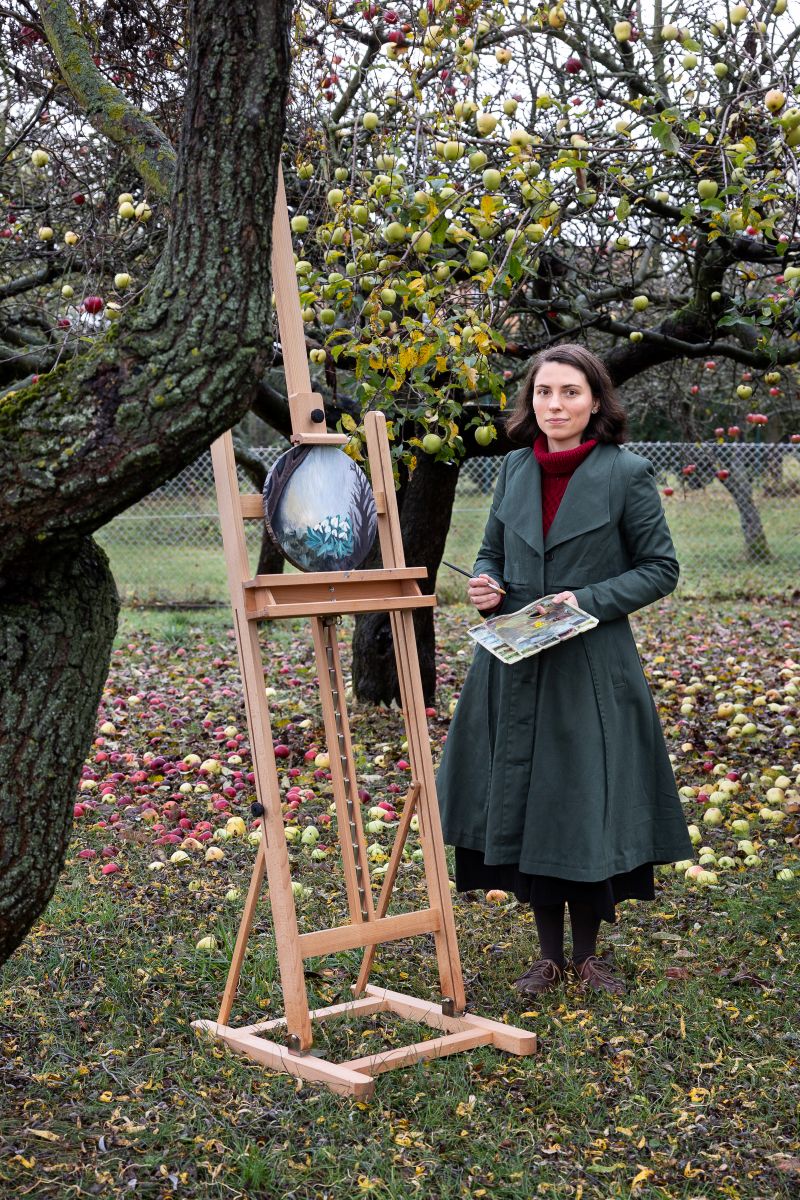
Mental hygiene is important. From a professional point of view, supervision helps, for example, but it is also important to have a private life and free time. I personally enjoy gardening and painting. And then I like stories. Not just biblical ones, but stories in general. So I like watching movies and reading books.
Which topics appeal to you most in films and literature?
I really like science fiction and stories that have some kind of deeper meaning. I’m a bit of a philosopher, so I appreciate the poetry in books and various cinematic works. For example, I really liked the series 1883, which is basically a western set during the settlement of America. It is about a group of settlers traveling the Oregon Trail as their stories are told.
And can the pastor take a vacation and go to Oregon to see what it’s really like there?
Yes, even pastors get vacations. Of course, it’s probably not the best idea to take one over Christmas or Easter, but otherwise I can take one whenever it makes sense. Since it affects the entire functioning of our community, my colleague from Chrudim and I try to plan ahead. When we know that one of us will be away, we need to think through a number of things – for example, who will preach on Sunday, whether there will be weekly groups, and other organizational matters.
| Eliška Vančová |
| Graduated from the Protestant Theological Faculty of Charles University, now pursuing a doctorate at the faculty on the topic of ordination and ordained ministry in the Evangelical Church of Czech Brethren. In 2023, she received the Josef Hlávka Award for her master’s thesis “Attitudes towards same-sex couples in the Evangelical church of Czech brethren”. She now works part-time as a pastor in Chrudim and Heřmanův Městec. |