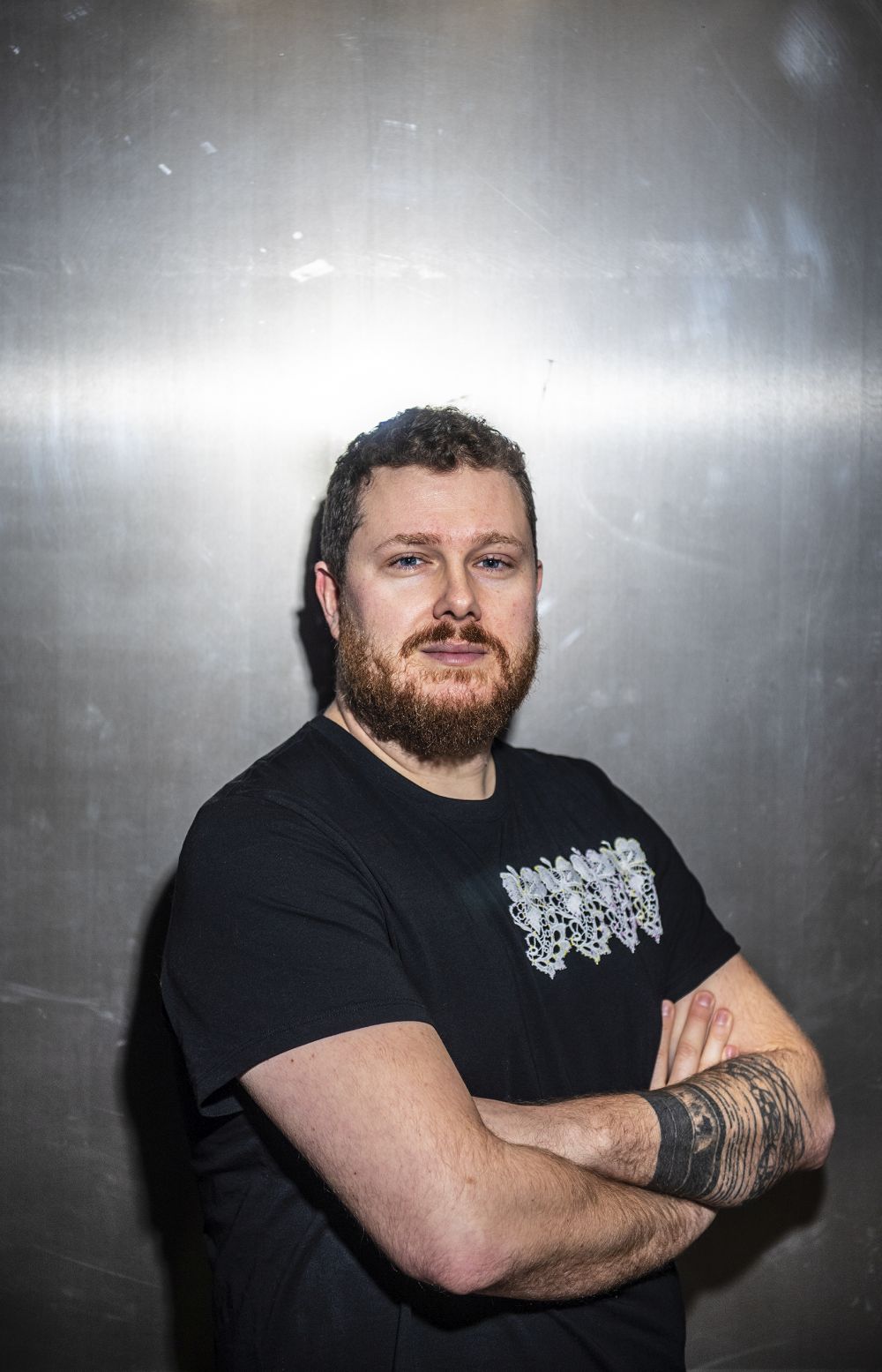


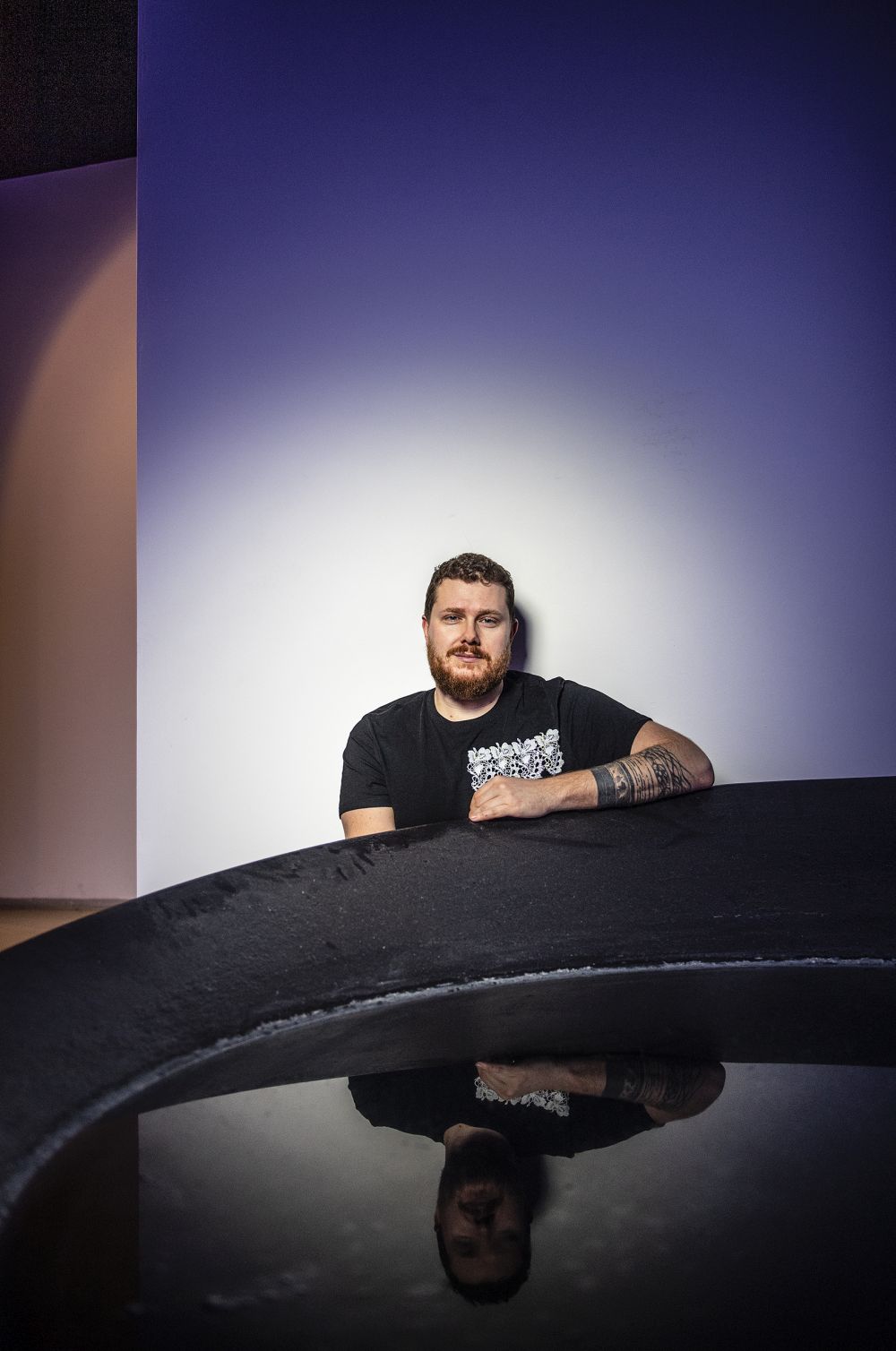
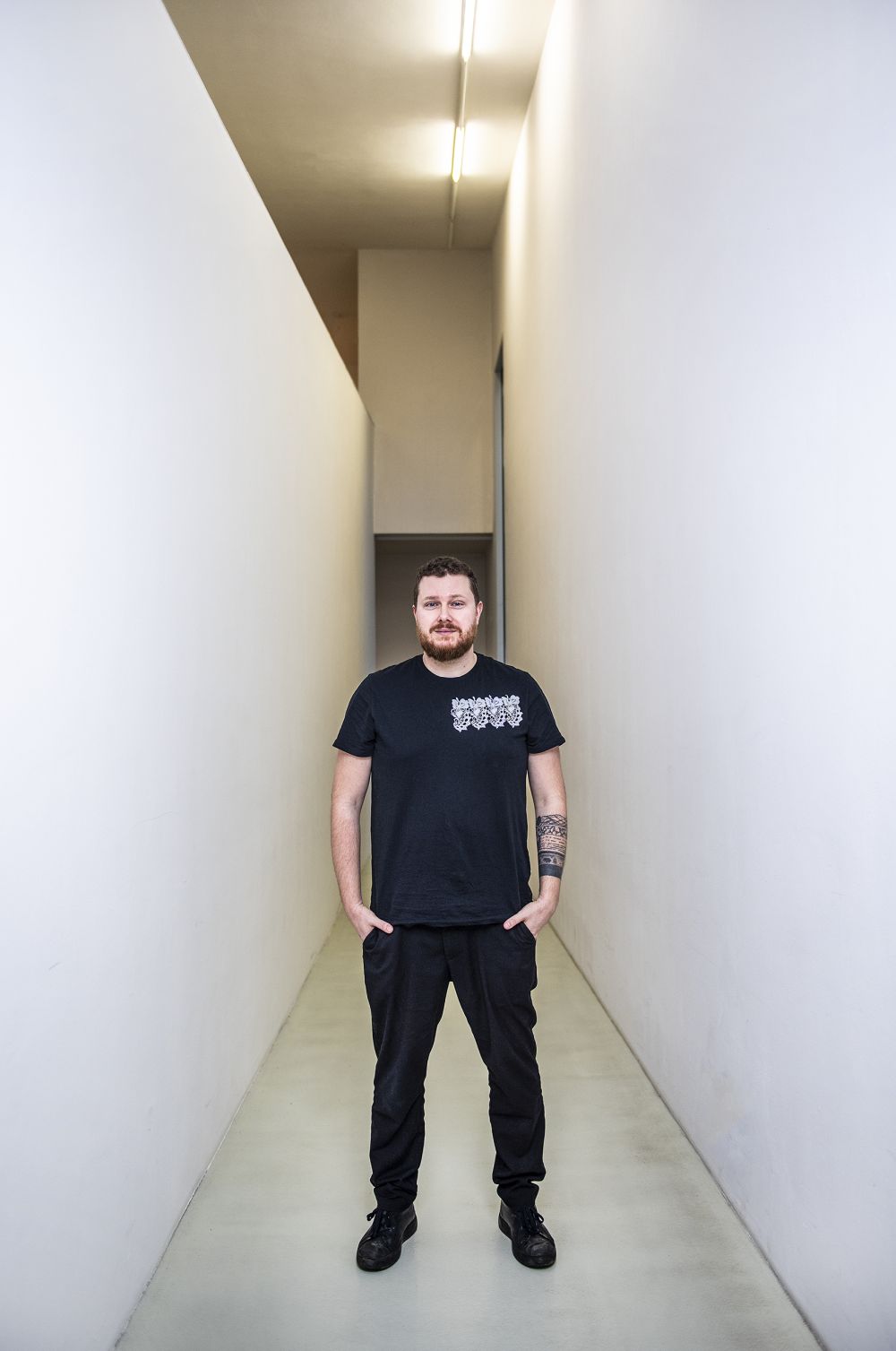
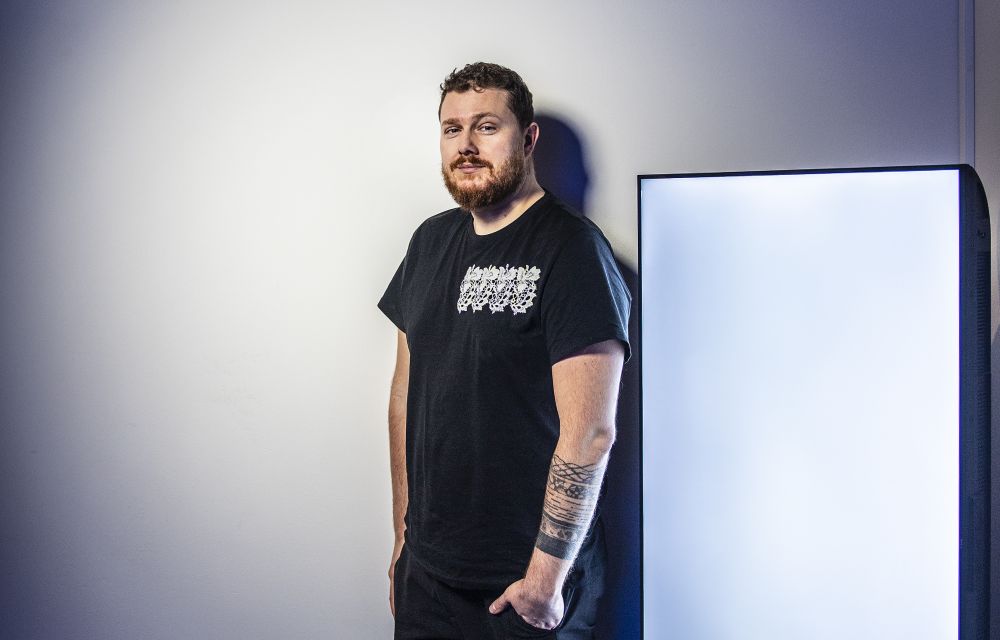
He considers virtual reality to be a powerful mode of immersing oneself in another person’s experiences, allowing one to empathize more deeply with their situation. His work touches on deeply personal topics such as depression, anxiety, and life during times of war. Ondřej Moravec, a graduate of the Faculty of Social Sciences at Charles University and FAMU, teamed up with Ukrainian artists to create two VR projects that allow viewers to look into the eyes of the residents of war-torn Kharkiv or experience for themselves what their living room would look like after a bombing.
Your last two VR films brought you to Ukraine. How did these projects come about?
When Russia launched a full-scale invasion of Ukraine in 2022, we were all deeply affected. There was a wave of sympathy for Ukraine within my circle, but I asked myself what else I could do besides donating money. This reflection led me to decide to try to artistically portray and convey the emotions that come with finding oneself in a war.
Together with Brainz Immersive, the company I work with on all my projects, we decided to reach out to Ukrainian artists. We wanted to give them an opportunity to work for their country through art, because they themselves did not have many possibilities at that time. We knew that creating a VR project takes two to three years at best, if everything goes smoothly, including financing. Nevertheless, we started working on the Fragile Home project in 2022. But then the Ministry of the Interior approached us to create a virtual reality experience that would help Czechs perceive migrants from Ukraine more positively. That's why we finally decided to shoot two projects.
We gave Fragile Home time to mature and develop in the standard filmmaking way, while the other film, which we named Fresh Memories: The Look, came together more quickly. We travelled to Ukraine for four days to shoot it. We approached it as an immersive experience, where the viewer looks people from Ukraine in the eye and forms a connection with them. I was inspired by Marina Abramović and her famous performance The Artist is Present, where she sat behind a table at the Museum of Modern Art in New York and maintained eye contact with visitors. I was interested to see if such an emotional bridge would work in virtual reality and in the context of war.
You have confirmed that the connection functions in virtual reality as well…
We submitted the project to the South by Southwest (SXSW) festival in Austin, Texas, where we were eventually accepted, which was the first sign that our chosen method was working. We then had a several-month exhibition in Prague at the DOX Centre for Contemporary Art. The project then began touring festivals and enjoyed great success, which made me very happy.
You collaborated with Ukrainian artist Volodymyr Kolbasa on the Fresh Memories: The Look project. How did your ideas complement or clash with each other during your joint work? You viewed the situation indirectly, while he saw it as a citizen of the attacked country…
We met during the One World festival at a meeting of filmmakers, where Volodomyr presented his then current project. However, he mentioned that under the current circumstances, he would rather create something about the war. That was the spark for me. He was only connected online at the time, but I approached him with the idea that we could try to create something together. We worked on the concept only through online meetings, which complicated our mutual connection. Our expectations and reality were sometimes at odds.
I told him at the time that our partnership could be strong precisely because he brought a strong Ukrainian perspective and personal experience to the project, while my contribution was, on the contrary, in my detachment. Volodymyr didn't have much experience with VR. For example, he wanted to include much more brutal violence committed by Russian soldiers against Ukrainian people in the film. I understood that, but at the same time I had to remind him that VR is a very intense medium. If you put overly expressive content into it, people will stop absorbing it and disconnect. Instead of building a bridge, it would rather disrupt the relationship. That was the main area where we had to balance our views.
Filming Fresh Memories: The Look took you right into bombed-out Kharkiv. What was the experience like?
It was really tough. Just as we set off for Kharkiv, more massive bombing started. In the end, I had to leave my camera there and return to Czechia. We stayed in touch with the Ukrainian crew remotely. They continued filming in Kharkiv, and I supervised the editing in Czechia.
Your second project dealing with the war in Ukraine is called Fragile Home. What is it about?
While Fresh Memories focused on people and the connection with a virtual individual, Fragile Home worked with space and the fragility of home when faced with a threat such as war. We originally planned a classic VR film with 3D animation, but in late 2022, we decided to go with mixed reality. This means that when you watch the film through a headset, you see your real surroundings thanks to the cameras mounted on it, but 3D objects are projected onto the interior you are in – a window of a Ukrainian apartment, a couch, and so on. Your space is thus “transformed” into a Ukrainian home. Then you see what happens to your home when war tears through it.
You also collaborated on this project with an artist of Ukrainian origin, Victoria Lopukhina.
Working with Victoria was great because she used to work as a film architect and knew how to represent a Ukrainian household. We told her that the apartment had to look Ukrainian, but not like a folk museum, otherwise it wouldn’t seem authentic. Speaking of which, I just remembered a fun story. She suggested putting a broom in the hallway that looked like it was from the 19th century – just a few twigs tied together. I was against it because it didn’t look contemporary at all. In the end, I got my way, but when Victoria had to return to Ukraine, she sent me a photo from her house where she actually had this exact broom (Victoria Lopukhina did not live to see the film’s premiere because she succumbed to a serious illness – ed.).
Let’s look back at your VR debut, Darkening, which deals with living with depression and is rooted in your own experiences with this illness. Why did you choose such a personal topic and decide to explore it in virtual reality?
It is said that the first topic should be personal, because it is easiest for the author to tackle. Originally, I didn’t want to make a film explicitly about myself, but in the end, I decided to use myself as a guinea pig. The One World festival, where I worked as a programme director, was the first Czech festival to include VR, and I was absolutely captivated by the medium. I noticed that VR often deals with personal experiences, so depression seemed to me a very fitting theme for it.
In the film, you mention that your depression developed after you entered university. What was so difficult for you at that time?
I think the transition from a small eight-year grammar school in Říčany, where I had been in a safe group for eight years and was top of my class, to a large school in Prague was crucial. Suddenly, I was in an anonymous environment, no one knew me, there were so many of us in the class, and the teacher-student relationship was completely different. This began to disrupt my fragile system and created space for the development of depression.
Looking back now, what would have helped you as a student at that time to prevent the depression from taking hold?
It’s hard to say with certainty, but I think it would help if society was more understanding of the fact that starting college is extremely challenging for young people. While in high school you are still somewhat “protected” by your home and parents, in college the world opens up much more. Many university teachers may not realise this, as they are already settled in their lives and cannot always empathise with the students’ needs.
When it happened to me (around 2004–2005), it wasn’t common to talk about these things. The university didn’t have the kind of programmes it has today. The school psychologist had limited hours and it was difficult to get an appointment with her. When I did get there, she wasn’t able to refer me anywhere else, which reinforced my feeling that I couldn’t get any help. On the other hand, when the illness fully broke out and I attempted suicide in my first year, the then head of the department, Barbora Osvaldová, was immensely supportive and understanding. I felt safe and accepted with her. Thanks to that, and thanks to the treatment, I recovered relatively quickly and finished school, which many people with depression may not be able to do.
I still come across teachers who tend to suspect students of feigning mental health issues in order to obtain an individual plan. This hurts people terribly. It would help if there wasn’t such a “don’t be exaggerating” attitude.
You’ve opened up this topic to young people heading to college as well, with screenings of Darkening for high schools. What did you take away from that?
It was a wonderful, but in some ways also sad experience. I saw that today's students and teachers are much more engaged with the topic than they were in my day, which is great. At the same time, however, I encountered teachers with whom we had to struggle a bit. I remember one teacher who claimed that all you need to do for people with depression is give them a vacuum cleaner and keep them busy. We tried to explain to her that at certain stages of the illness, people are simply incapable of doing anything at all.
The debate with seniors from the Elpida club was also interesting. One lady claimed that young people shouldn’t watch such things, that they should only see beautiful things in VR. The rest of the group disagreed with her. The most important thing for me was when people came up to me after the screening and thanked me for bringing up the topic and allowing them to identify with someone. The fear of being excluded from society is enormous with this disease. Even today, when I have deep lows, I am afraid it’s not going to get any better. The goal of treatment is to learn that it’s just a phase that will pass. Even in popular culture, it’s great that stars share that they are struggling with mental health issues; it is very empowering.
Why is virtual reality as an artistic expression so powerful for you?
Literature works with inner imagination, film with visual and auditory perception from a distance. But in VR, you find yourself directly inside. You are invited not only on a rational level, but also on the physical level. In the Darkening project, we work with the viewer’s body through voice. People are motivated to use their voice because voice therapy has worked very well for me personally. When you are physically involved in the story in this way, you experience it in a completely different way. There is great power in that.
You graduated in journalism, worked for Czech Television as a reporter, and for the One World documentary film festival as programme director. Does the documentary approach still prevail in your own work, are you not tempted by fiction?
All my projects are rooted in reality in some way. My latest project, 6 Degrees, which I am working on in collaboration with the ME-SA art platform, is not exactly a documentary, but it addresses the climate crisis, so in a way it also relates to what is currently happening.
I like that VR isn’t just about escaping into fantastical worlds but can take us deeper into the heart of actual reality and vividly show us, for example, what it’s like to experience anxiety or depression.
My new project, Melody of Unrest, is a kind of docufiction about performance anxiety. When writing the story, I was inspired by my great-uncle Ivan Moravec, a famous pianist who had sold out Carnegie Hall but at the same time suffered from performance anxiety. I am treating it as a story from the animal kingdom. The viewer finds themselves in the body of a young nightingale who cannot sing but falls in love with playing the piano, even though it suffers from stage fright. Through this experience, the viewer learns methods for alleviating anxiety. Although it is fiction, it is strongly rooted in reality. Working on documentaries has taught me that the line between documentary and fiction is illusory. No documentary is 100% authentic; it always reflects the author’s point of view. Even major film festivals such as Karlovy Vary, Venice, and Berlin have recently abandoned documentary categories and instead screen films together because this division is outdated. The same applies to virtual reality.
Your films have been featured at film festivals, in galleries and museums. Do VR projects belong in the cinema or rather in a gallery?
Since VR development has been tied to film from the outset, projects began to appear at film festivals. Distribution models for cinemas with special auditoriums were also tried, but it turned out – primarily in France, the European leader in virtual creation – that this did not work very well. People in movie theatres are not in the right mindset. Museums and galleries work much better. VR experiences usually last 20 to 30 minutes, which complements a visit to an exhibition, where you spend more time with the art. Since around 2020, galleries have been the main distribution platform.
So where can viewers currently see your VR projects?
At the NaFilM museum in Prague, we have a long-term exhibition of the film Darkening, which will run until mid-2026. We are discussing replacing it with Fragile Home afterwards. The latter has also been available online for several weeks, so anyone with a headset at home can run it in their living room. It was created precisely for this purpose, to allow people to experience what it feels like when war enters their home. Since mid-February, Fragile Home has been on display at the Regional Museum in Olomouc. Fresh Memories: The Look is also available online, and 30,000 viewers have already seen it on the Meta TV platform, which we are thrilled about. Although VR is said to have limited distribution, it turns out that with a good strategy, you can achieve decent numbers.
| Mgr. Ondřej Moravec |
| He graduated in Journalism and Media Studies from the Faculty of Social Sciences at Charles University. He then went on to study screenwriting and dramaturgy at FAMU. He worked for Czech Television’s Culture Newsroom department. For many years, he worked as a programme director for the One World documentary film festival. In 2022, he debuted with his first VR film Darkening (nominated for the Czech Lion Award for Best Animated Film). His next two VR projects focused on the war in Ukraine. Last year, the creators of Fragile Home won two awards at the Annecy International Animation Film Festival in France. Currently, he is working on a new VR project, Melody of Unrest, which addresses coping with performance anxiety. He is also preparing another VR project, Odplouváš, which touches on the theme of old loves. In addition to his own creative work, he has been organizing the ART*VR festival of virtual reality and immersive art in Prague for several years. |